 GainsLog
The Best Free Workout Tracker for iPhone in 2026
GainsLog is the only free iPhone tracker that combines adaptive next-session targets, momentum tracking, and unlimited workout logging. No ads. No routine caps. No paywall on the core training loop.
Table of Contents
Every workout tracker app promises to be free. But "free" means wildly different things depending on which app you download.
Some lock basic features (like saving more than three routines) behind a paywall. Others show you ads between sets. A few are genuinely generous. The differences matter because the app you pick determines whether you'll actually use it long enough to see results.
We broke down the free tiers of the most popular iPhone workout trackers so you don't have to. Here's what you actually get for free, what's locked behind a subscription, and which app gives you the best shot at making real progress without spending a cent.
What a Workout Tracker Actually Needs to Do
Before comparing apps, define what actually matters. A workout tracker needs to log sets quickly without friction, give you access to previous session data so you can chase progressive overload, let you save customizable routines, and provide some form of progression guidance so you're not guessing what to do next.
Most lifters don't need a social feed or AI-generated programs. They need something that gets out of the way, logs their sets, and tells them whether they're improving. Everything else is decoration.
Strong
Strong is the industry standard for workout tracking UI. Clean and fast. But the free tier is crippling: you're limited to three routines. That's not enough for anyone running a real program. A basic push/pull/legs split already uses your entire quota, with nothing left for accessories or a second program.
Premium costs $29.99/year or $99.99 for a lifetime unlock. The app is good enough to justify it for some people, but paying for the ability to save more than three routines feels like a tax on basic functionality.
Hevy
Hevy is the social-first tracker. Activity feeds, follower counts, workout sharing built into the core experience. The free tier gives you four routines and seven custom exercises. Slightly more generous than Strong, but still limiting.
If you want community and motivation from seeing what other people are lifting, Hevy does that well. But if you just want to log and progress, the social features are noise, and the free tier's restrictions will start pinching within a few weeks.
RepCount
RepCount has a genuinely generous free tier. Unlimited workouts, unlimited routines, unlimited exercises, no ads. Simple and fast. It does the basics extremely well.
Premium ($29.99/year) adds analytics and charts. The limitation isn't what RepCount charges for. It's what it doesn't have. There are no built-in programs and no progression system. It's an excellent digital logbook, but it won't tell you what to do next or whether your training is actually working. You bring the plan; RepCount just records it.
JEFIT
JEFIT has one of the largest exercise databases of any tracker, with over 1,400 exercises including detailed animations and instructions. The free tier is ad-supported with banner ads between screens, and advanced analytics are locked behind JEFIT Elite ($69.99/year).
The exercise library is genuinely impressive. But the ad experience during workouts is distracting, and the interface feels dated compared to newer competitors. JEFIT was ahead of its time a decade ago, but the app hasn't kept pace.
StrengthLog
StrengthLog has a solid free tier for basic logging with unlimited routines, a large exercise library, and useful calculators. The app is well-designed with good content.
The catch: the structured, coach-written training programs require Premium. And at $109/year, StrengthLog is the most expensive tracker on this list by a wide margin. Nearly four times what Strong or RepCount charge. The content behind that paywall is good, but the price ceiling is steep. There's also no adaptive progression system. The programs are structured, but they don't adjust to your performance.
FitNotes
FitNotes is worth mentioning. The original Android version is 100% free with no ads and no catches. There's now an iOS version (FitNotes 2), but it's a separate app with a freemium model: the free tier caps you at 12 saved workouts, then it's $14.99/year or $44.99 lifetime.
The Android version remains one of the most honest apps in the space. The iOS version is more limited on free than most of the other apps on this list. No cloud sync on either platform, so your data lives on your device.
Where GainsLog Fits In
GainsLog's free tier includes unlimited workouts with no caps, up to six custom workout templates, basic momentum tracking after each session and on the start page, workout history, and no ads.
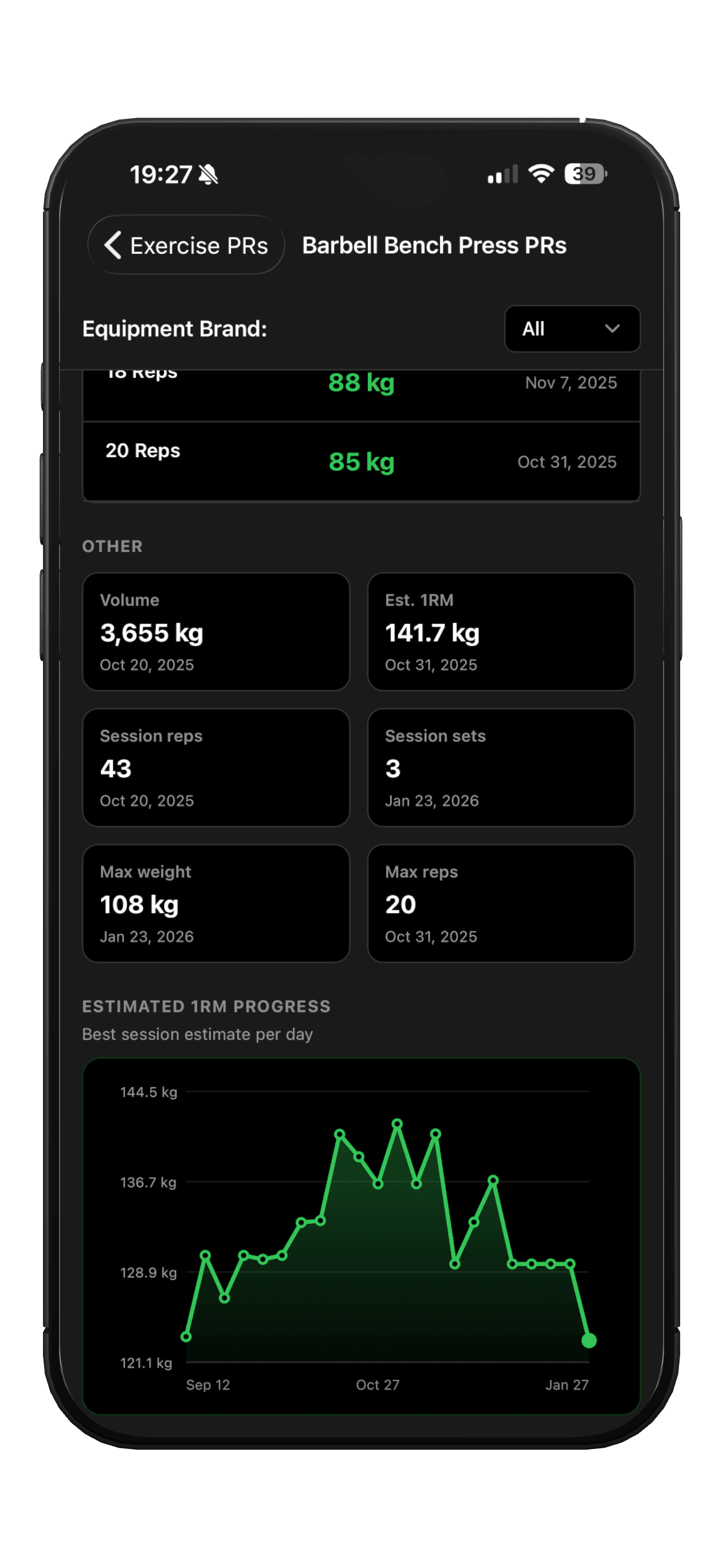
The free tier's real differentiator is what the app does with your data. GainsLog doesn't just log what you did. It tells you what to do next. After every session, the app evaluates your performance and sets adaptive targets for your next workout: weight and rep goals based on what you actually lifted. Hit your rep target? The weight goes up. Didn't get there? You keep the same load and push for more reps. No other free tracker does this.
RepCount is a great logbook but won't guide your next session. Strong and Hevy lock too many basics behind a paywall. StrengthLog locks its structured programs behind $109/year. GainsLog is the only free option where the core training loop (log, get targets, progress) works without paying.
Premium ($20/month) unlocks structured programs, a program builder that generates personalized programs based on your preferences, detailed momentum and muscle group trend analytics with filtering, progression insights, and premium templates. But the foundation that actually drives your progress (adaptive targets, momentum feedback, unlimited logging) is available on free.
Why Structure Matters More Than Features
Most tracker comparisons focus on feature counts. Exercise database size, theme options, social features, Apple Watch support. Those things are nice, but they don't determine whether you actually make progress.
The feature that matters most is structure: does the app help you progress systematically? A tracker with unlimited routines but no progression system is a digital notebook. A tracker with adaptive targets and momentum feedback is a training partner.
Progressive overload is the foundation of GainsLog, not a premium add-on. The app is built around the idea that tracking only matters if it feeds back into your training. Logging sets without knowing whether you're improving is just note-taking. Logging sets and getting told exactly what to chase next session is training.
Picking the Right Tracker
The honest answer is that the best tracker depends on what you value. If you want the simplest possible logger with zero restrictions, RepCount is excellent. If you want community and social features, Hevy. If you want coach-written programs and are willing to pay $109/year, StrengthLog.
But if you want a free tracker that actually guides your training (adaptive targets, momentum feedback, progression tracking), GainsLog is the only one that does it all without charging you first. The core training loop works on free, and it's the same loop that drives results: log your session, get targets for the next one, progress over time.
The app you use matters less than whether you use it consistently. But if the app you pick actively helps you progress instead of just recording what happened, you're stacking the odds in your favor.