GainsLog

How to Train While Cutting Without Losing Muscle
Energy deficit is recovery deficit. Pull volume back by 20-33%, keep the heaviest sets heavy, and treat your top-set numbers as the muscle-retention check. If the bar is still moving the right way, the muscle is staying. If it's sliding, you have a few weeks to fix it before the loss is real.
Table of Contents
The lifts start backing off in week three. A rep here, half a rep there. The scale is moving the right way, you tell yourself the strength will come back when the food does, and you keep grinding through the same program you ran on bulk calories. Eight weeks later you're leaner and visibly smaller. The fat went, and it took some muscle with it.
This is the most common cutting failure, and it has nothing to do with willpower or food. It's a training problem. The training that built the muscle on a surplus is the same training that strips it on a deficit, because the body has less recovery to spend and you're spending it the same way.
Most People Train Wrong on a Cut
Two failure modes account for almost every botched cut.
The first is the obvious one: same training, less food. The volume that was barely productive on a surplus becomes net negative once recovery drops. You feel slower in the gym, the lifts crawl, and you tell yourself it's just diet fatigue. It is. But the diet fatigue is being amplified by training that no longer fits the calorie environment you're in. Holding bulk-level volume on cutting calories is the single most common reason a cut eats muscle along with fat.
The second mode is the opposite reaction. The lifter feels tired and undermotivated, drops the heavy work, and switches to high-rep pump sessions that feel manageable. The plan to "save real training for after the cut" sounds reasonable. The pump is comforting. It also doesn't keep the muscle on, because nothing in those sessions is signaling the body that the tissue still needs to be there.
Both failures share a root cause: the cut is being run as a single-goal phase. Lose fat. The actual goal is two things at once. Lose fat AND keep what you built. The training plan has to be built around the second goal, because the first goal mostly takes care of itself once the calories are right.
Your Top Sets Are the Diagnostic
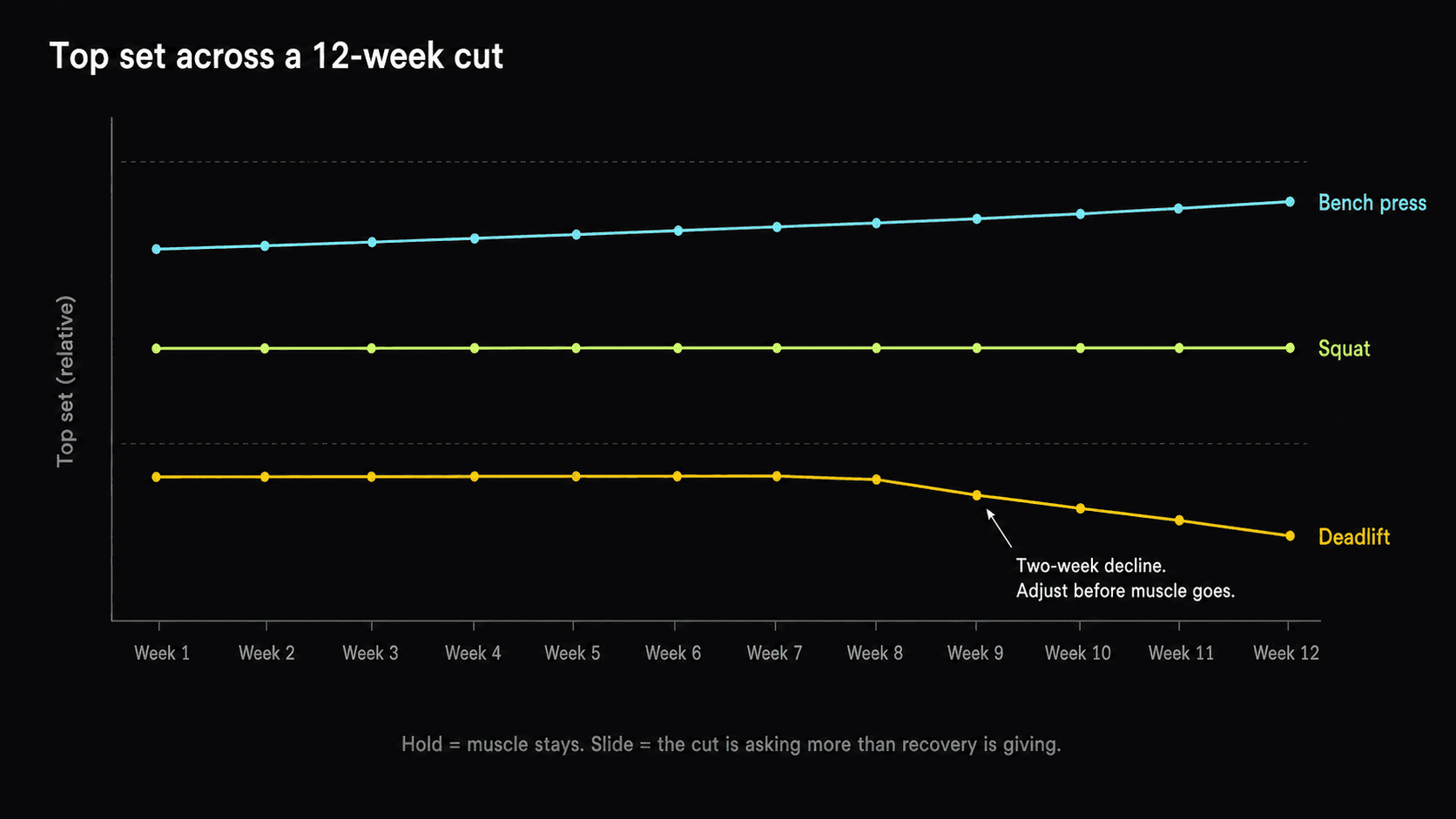
The scale tells you about fat. The bar tells you about muscle. If you're losing weight and your top sets are holding, the muscle is staying. If the top sets are sliding, the loss is more than fat.
Top sets means your heaviest working set on each main lift. Bench, squat, row, overhead press, hip hinge, whatever the spine of your program is. Those are the sets that carry the strength signal. Accessory work doesn't, because accessory work is too sensitive to fatigue to read cleanly.
A small drop in any given week is normal. A bad night of sleep, a stressful week at work, a weekend that wrecked the food. One off session means nothing. A pattern over two or three weeks means something. If the same lift backs off three sessions in a row, the cut is currently asking more than your recovery can provide, and something has to give.
New PRs early in a cut are possible, especially for less experienced lifters whose training has more headroom. Don't expect them. Don't sandbag, either, by assuming strength has to drop because the food is down. The default assumption should be that your top sets hold for the entire cut. If they don't, that's the signal to adjust, not a normal cost of doing business.
Cut Volume, Keep the Bar Heavy
Twenty to thirty-three percent less total volume than what you ran on a bulk. That's the working range, and it's a real range backed by the research, not a vibe. If you did 14 sets per week for chest on the bulk, you're at 9 to 11 on the cut. If you did 10, you're at 7 or 8. There's even a Ramadan fasting study where athletes built strength faster after pulling volume by 22% during the fast than when they kept their previous volume on the same low calories.
The sets that come off are the back-end ones. Accessory exercises. Burnout sets. The third movement for a body part that was already covered by the first two. Not the heavy compound you've been progressing for the last six months.
A useful filter: if a set's job is to drive strength up over time, keep it. If a set's job is to pump the muscle or stretch the volume number, cut it. The strength-driving sets do double duty during a cut. They produce the muscle-retention signal AND give you something concrete to track. Pump sets do neither.
Frequency stays the same. This is the part most people get backwards. When energy is low, the temptation is to consolidate into fewer, longer sessions so there's a real rest day in between. That makes the recovery problem worse, not better. Two short hard sessions per muscle per week recover faster than one long session that empties you out. Cut session length, keep session count.
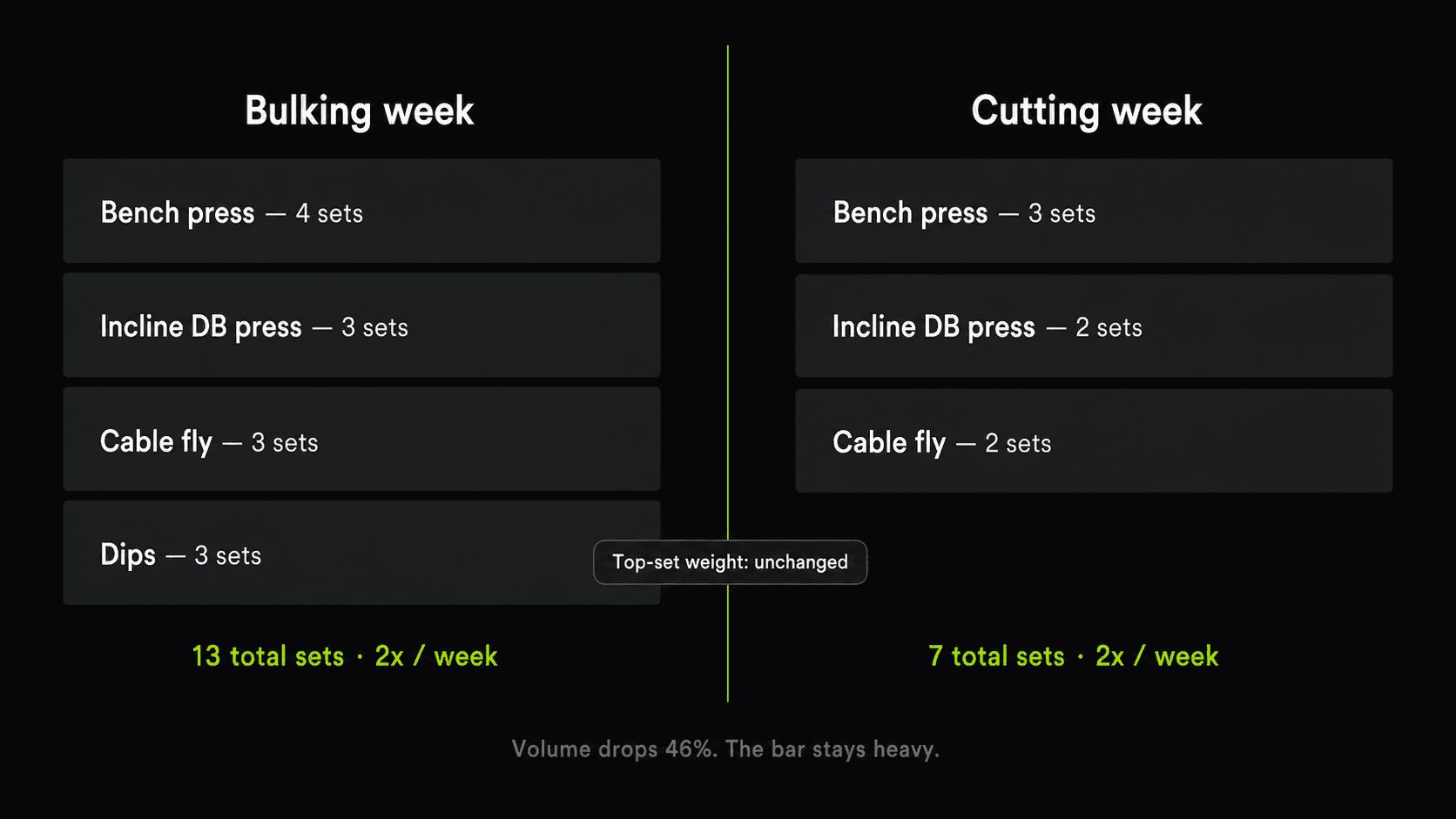
A concrete rewrite. Bulking week for chest: bench press 4 sets, incline dumbbell press 3 sets, cable fly 3 sets, dips 3 sets, twice a week. Total 13 sets. Cutting version: bench press 3 sets, incline dumbbell press 2 sets, cable fly 2 sets, twice a week. Total 7 sets. The bench numbers don't move. The accessories shrink. The frequency holds.
Reverse Pyramid Is the Cleanest Scheme for a Cut
There's a specific way to set up the lifts that handles all of the above by design. Heaviest set first, then drop the load and add reps. Old-school lean lifter protocol. It exists because the people who used it were cutting most of the time and needed every set to count.
Sample template on bench press. Set 1 at your goal weight for 6 reps. Set 2 at 10 percent less for 8 reps. Set 3 at 10 percent less again for 10 reps. Three sets per main lift, that's it. No fourth set, no accessory volume on the same movement.
Why it works on a cut specifically: the strength signal lives in set one, when you're freshest. You hit the heaviest weight before fatigue degrades your bar speed and your form. The back-off sets give you some volume at lower neural cost. The total is small enough to recover from on cutting calories, and the structure forces you to train every working set close to failure (because there's no room to coast through five extra sets).
This isn't the only scheme that works. A standard straight-set program with two or three working sets per exercise instead of four or five covers the same ground. Reverse pyramid is the cleanest mental model. Pick whichever you'll actually run consistently, because the program you stick to beats the program that's slightly more optimal on paper.
What You Don't Need to Add
Protein doesn't need to go up on a cut. The widespread claim that protein requirements rise in a deficit isn't supported by direct research, and the research that exists points the other way. The same 1.6 to 2.2 grams per kilogram of bodyweight that worked on a bulk works on a cut. If you were already in that range, leave it alone. The hours spent stressing about whether you hit 220 grams or 240 grams of protein on a cutting day are hours that would have been better spent sleeping.
Cardio is a tool to widen the deficit, not a separate goal. Use the smallest amount of cardio that lets you hit the rate of fat loss you want. For most people, that's a daily walk and that's it. Aggressive cardio competes with the gym for the same recovery budget you're trying to protect. The deficit should mostly come from food, with walking as the easiest top-up.
Don't add intensity techniques you weren't already using. Drop sets, rest-pause, partials, lengthened-bias work. These add stimulus, which sounds appealing when you're worried about losing muscle. They also add fatigue at exactly the moment your recovery is lowest. A cut is the wrong time to introduce new training variables, the wrong time to switch programs, the wrong time to chase a different style of training. Run what you already know works, with less of it.
How Long, and When to Stop
Eight to twelve weeks is the standard cutting block. Shorter doesn't move enough fat to be worth the disruption to your normal training. Longer accumulates diet fatigue that breaks adherence and starts costing you more than the deficit is buying you.
Stop signals worth taking seriously. Strength dropping consistently for two or three weeks. Sleep going off the rails. Mood in the gutter. Hunger that's no longer manageable. Any one of these is a real signal. Two of them at once is the cut telling you it's done.
The actual finish line isn't a body fat percentage. It's the point where the cost of going further (lost training quality, lost sleep, sour mood, eventual rebound eating) is higher than the benefit of getting another percentage point leaner. Most people would be better off ending a cut a couple of weeks earlier than they think and going back into a normal training block, instead of dragging a deflating cut into a twelfth or thirteenth week and falling off completely.
After the cut, don't jump straight into a surplus. A two to four week maintenance block lets diet fatigue come down, lets training fatigue clear, and gives the next bulk an actual runway. Skipping this step is how good cuts turn into bad bulks.
How GainsLog Helps You Read the Strength Signal
The whole article hinges on one signal: are your top sets holding. The signal hinges on a record. Without a log, you're guessing whether yesterday's bench was a rep up or a rep down from last week, and the guess is going to be wrong.
GainsLog tracks your top set per exercise across weeks, so the trend is visible. You don't have to remember whether your bench has crept down. You can look.
During a cut, the log becomes the early-warning system. Two weeks of slow decline on a main lift tells you, before you're visibly smaller, that something needs to change. Maybe a few extra hundred calories that week. Maybe an extra hour of sleep. Maybe ending the cut earlier than planned. The point is you find out in time to do something about it, not in the mirror six weeks from now.