 GainsLog
How to Get Out of Skinny Fat (Without Doing More Cardio)
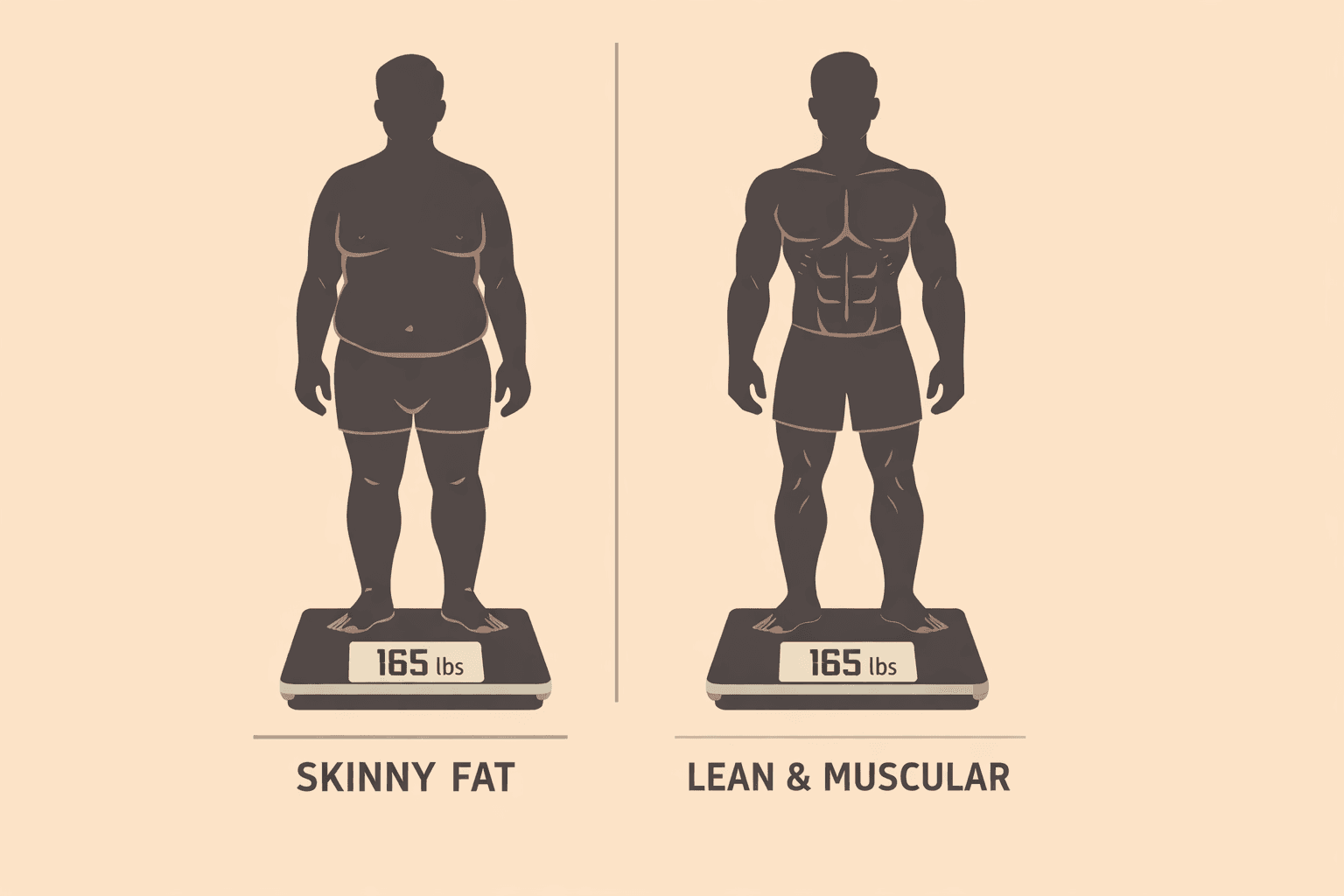
Cardio alone makes you lighter without changing what the mirror shows. Building muscle while losing fat is how body composition actually changes, and beginners have a window to do both at once. Use progressive overload as your check: if you're lifting more each week, the recomp is working.
Table of Contents
You lost 8 kilos over four months. You stopped eating junk, you ran three times a week, you tracked calories on and off. The scale moved. Your shirts fit better at first. But you take off your shirt, look in the mirror, and the body staring back looks soft and undefined in the exact same places it always did.
This is the skinny fat trap. It's not a fat loss problem. It's a body composition problem, and the tools most people reach for, cardio and caloric restriction, aren't designed to solve it.
The Cardio Trap
When you look soft and undefined, the instinct is to run until the fat goes away. It's the wrong move.
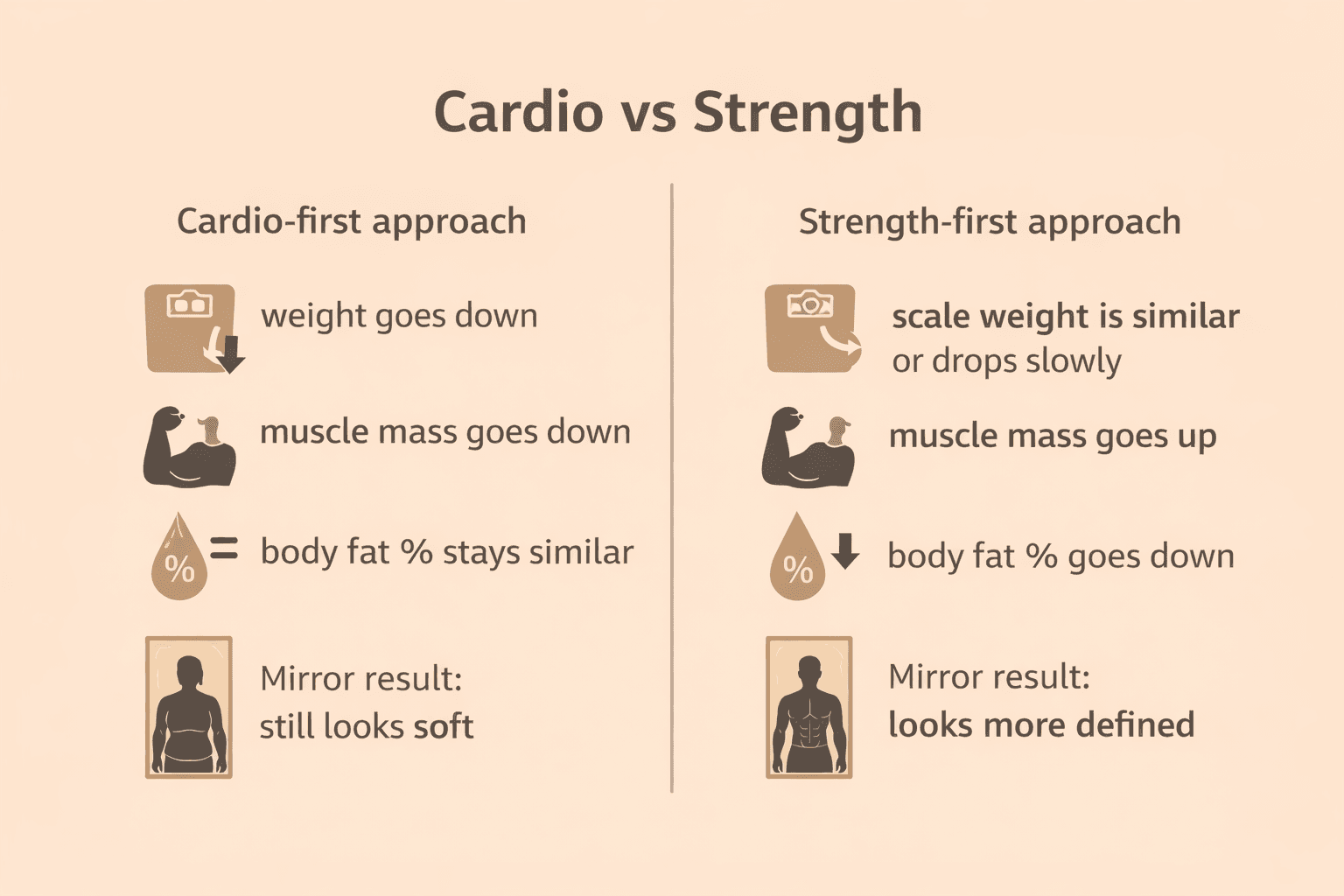
Cardio produces weight loss without changing your body composition. If your body doesn't have much muscle underneath the fat, burning the fat off just reveals less of the same soft, undefined shape. A smaller version of skinny fat is still skinny fat.
Worse, long cuts driven by cardio tend to eat away at the little muscle you have. You become lighter and flatter at the same time. The scale moves, your clothes hang differently, and the mirror still disappoints you. That's the default outcome when fat loss happens without a stimulus telling your body to hold on to muscle.
Cardio also has no built-in signal that anything useful is happening to your shape. Running more kilometers doesn't make the mirror better. You can train cardio perfectly for six months and come out of it smaller, softer, and no more defined than when you started.
What Recomposition Actually Is
Body recomposition is losing fat and building muscle at the same time. For experienced lifters it's rare. For beginners and people returning after a long break, it's the default response to training properly.
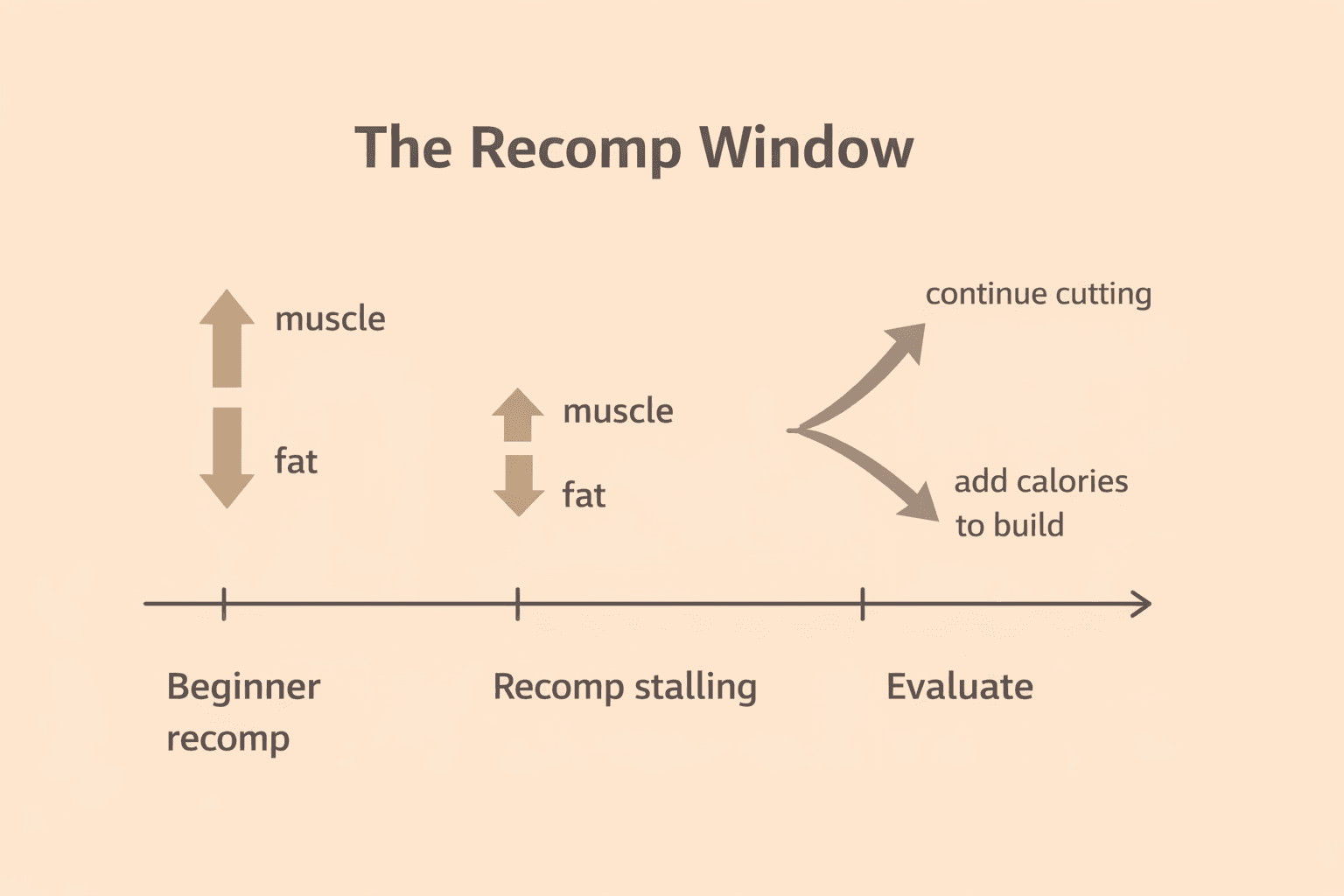
The reason is that untrained muscle tissue responds strongly to the right stimulus, strongly enough that even a modest caloric deficit doesn't block the adaptation. Your body has a clear signal that muscle is needed, and it prioritizes building it even when total energy is slightly low. That window closes as you gain experience. For a year or two, you get to lose fat and build muscle simultaneously. After that, the trade-offs between cutting and building get sharper.
The confusing part is that the scale barely moves during a recomp. You might drop a kilo over three months while your shoulders fill out and your waist tightens. If the scale is the only thing you track, it looks like nothing is happening. This is why people abandon the approach before it pays off. They expect the number to drop, and when it doesn't they think the plan is broken.
The relevant metric during a recomp is whether you're lifting more over time. If you bench-pressed 60kg for 6 reps six weeks ago and you can do 65kg for 6 reps now, your body is adapting. Muscle is being built. That's the feedback signal the scale can't give you.
How to Actually Train
Strength training is the priority. Everything else, cardio included, gets organized around it.
If you're doing both in the same session, strength first. Cardio depletes the energy reserves your lifts need to actually be hard, and a watered-down lift produces a watered-down stimulus. Train strength fresh, and if you still have gas for cardio after, do it.
Train each muscle group at least twice per week. Once per week doesn't accumulate enough volume to drive growth, especially when your weekly target is reasonable. A push/pull/legs split gives you 2x frequency. A fullbody three times per week gives you 3x. Both work. A bro split that trains each muscle once per week doesn't.
Aim for 8 to 12 hard sets per muscle per week. Not 20. Not 30. The first handful of sets produce most of the growth, and each additional set is worth less than the one before it. If you're just getting out of skinny fat, the lower end of that range, 6 to 10 sets, is plenty.
The sets have to be hard. Within 1 to 3 reps of failure on most of them. If your sets end comfortably with reps still in the tank, they barely count. A training plan with 12 sets per muscle per week that are all easy produces less growth than 6 sets that are genuinely close to failure.
Eat enough protein. Around 1.6 to 2.2 grams per kilogram of bodyweight per day is the range most research lands on. Keep the deficit modest, roughly 10 to 20 percent below maintenance. A big deficit means a big recovery hit, which means less muscle-building signal gets through. Slow fat loss is the goal here.
The Check Is Simple: Are You Still Progressing in the Gym?
The recomp phase lasts as long as you can lose fat and gain strength at the same time. That's it. That's the rule.
If your lifts are going up week over week and you're slowly losing fat, keep going. Don't overthink it. This is the best training phase you'll have for a while, milk it.
If your lifts have stalled for several weeks and you're still in a deficit, something has to give. Usually the answer is to eat a bit more, at least back to maintenance, and let recovery catch up. People who grind long cuts with stalled lifts end up with less muscle than they started, which is the opposite of what they came for.
If you've been cutting for four months or more, take a break regardless of how progress feels. Go to maintenance for a few weeks. See how your body responds. You can always cut again, but you can't get back the months of stalled recovery.
When to Stop Recomping and Start Building
Eventually, the recomp runs out. You've lost enough fat that you don't need to keep cutting, and your lifts have slowed down enough that staying at maintenance isn't pushing you forward anymore. That's when you shift to building.
Bump calories slightly above maintenance, somewhere in the range of 200 to 400 calories over. Keep training the same way. You should notice faster progression on your lifts within a few weeks. Gaining a bit of fat along the way is fine, as long as it's slow. A proper lean bulk should add mostly muscle and undo very little of the fat loss you just earned.
Most people who get out of skinny fat don't do it in one clean cycle. They do a recomp, run out of easy gains, build for six to nine months, then cut again to reveal the muscle they added. The cycle repeats until they're where they wanted to be. The important part is that each phase is long enough to do its job. Cuts and builds that last four weeks each don't accomplish much.
How GainsLog Helps You Get This Right
The whole approach rests on one thing: knowing whether your lifts are actually going up. If you can't tell the difference between a productive training month and a wasted one, the entire system breaks.
GainsLog tracks your lifts session by session, so progressive overload becomes visible instead of hypothetical. You can see whether the recomp is working, whether your volume and intensity are producing adaptation, and when it's time to shift out of the cut. No guessing.
The apps built around step counting and calorie burn are optimized for weight loss. They're useful for that. But if your goal is to change what your body looks like, the tool you need is the one that tracks what's happening in the gym. That's what GainsLog is built for.