 GainsLog

Stretch vs Resistance Profile: The Two Levers Behind Every Good Hypertrophy Exercise
Two levers drive exercise selection. Stretch (lengthened-position training) is the principal mechanism for calves and a real lever for biarticular muscles like the triceps long head and rectus femoris. Resistance profile (how load varies across the ROM) is the lever for mono-articular cases like side delts and glutes. They coincide cleanly in a few exercises like the RDL. They pull apart more often than the trend admits.
Table of Contents
You've been hitting bench PRs for two years and your upper pecs still look flat. Your tricep pushdowns moved from 50 kg to 80 kg and the long head still doesn't fill out the back of your arm. The numbers are real. The growth isn't matching them. You're not crazy, and the answer isn't more volume or more intensity. It's that the exercises you've been progressing weren't loading the muscle where it actually grows.
Most evidence-based content right now points at the same answer: do stretched-position training. Lengthened partials, overhead extensions, deficit RDLs, the whole canon. The exercises are mostly right. The reasoning collapses two different things into one. Stretch and resistance profile are two distinct levers, both real, both with their own evidence. They sometimes coincide. They often pull apart. Sorting them changes which exercise wins for which muscle.
Two Levers, Not One
The first lever is stretch. When a muscle is held at its long end, hypertrophy signalling fires harder. The effect is real. It's the dominant mechanism for calves, and present in biarticular muscles where a secondary joint position can lengthen the muscle: triceps long head overhead, biceps long head with shoulder extension, rectus femoris with hip extension, lats overhead, hamstrings with hip flexion.
The second lever is resistance profile. This is just how the load varies across the range of motion. Some exercises are heaviest at the top (a dumbbell lateral raise, where the moment arm at the shoulder peaks at 90 degrees of abduction). Some at the bottom (an RDL, where the moment arm at the hip peaks when you're folded over). Some peak in the middle (a standing dumbbell curl, where the forearm is perpendicular to gravity at 90 degrees of elbow flexion). Cable exercises tend to sit flatter than free weights because the cable angle holds tension across the rep.
The two levers can coincide, and when they do you get exercises that punch above their weight. They can also pull in opposite directions, in which case the exercise gets credit for the wrong reason or fails despite looking right on paper.
The studies people cite for stretched-position training share a setup: a cable or dumbbell configured to put a biarticular muscle into its lengthened position. A 2024 trial compared cable tricep extensions overhead versus neutral arm and found 28.5 percent vs 19.6 percent triceps long head growth, with 34 to 39 percent lower loads on the overhead arm. A separate 2024 trial pitting Smith squats against leg extensions found the leg extension grew all three regions of the rectus femoris while the squat grew only one region of the vastus lateralis. An incline-vs-preacher curl RCT found the two grew different parts of the biceps, with incline favouring the proximal end. All three results are usually framed as wins for stretch and heavier loading at the lengthened position. The cleaner read: they're stretch wins.
The cable overhead extension isn't actually heavy at the lengthened position. When the elbow is deeply flexed and the cable runs near the line of the forearm, the moment arm at the elbow collapses, and the resistance is often largest near the top of the rep (similar to a pushdown). The incline curl isn't heavy at the bottom either. A dumbbell hanging straight down from a flexed shoulder produces almost no torque at the elbow because the forearm is roughly vertical, parallel to gravity. What these exercises put in the lengthened position is some load, even if not peak load. That seems to be enough.
Where Resistance Profile Is the Whole Story
For mono-articular muscles, or muscles where stretch isn't a usable mechanism, resistance profile does all the work. The clearest case is side delts.
Side delts are a small mono-articular muscle. There's no biarticular trick to lengthen them, no overhead variant that loads them long. The best side delt exercise still has a clear answer: cable lateral raise from behind the body.
Ask why and the answer is profile. A standing dumbbell lateral raise gives the side delts essentially zero load at the start of the rep, because the moment arm at the shoulder is zero when the arm is at your side. The load only shows up as the arm rises, peaking near horizontal. The cable lateral raise from behind the body keeps the load high through the start of the lift, because the cable line angles up and forward instead of straight down.
Same muscle. No stretch story to tell. The exercise with the better profile beats the one with the worse profile because profile is the entire story.
Glutes are another case where profile dominates, in the opposite direction. The hip thrust loads heavy at lockout, where the glute is in its short position. By the stretch principle this should be a bad exercise. It isn't, because the glute can produce its highest force in the short position. Match the resistance profile to where the muscle can actually generate force, and the exercise works.
Where Stretch Is the Dominant Mechanism (Calves)
Calves are the cleanest case for stretch as the principal mechanism. Multiple RCTs comparing full-stretch calf raises to partial-ROM versions, and even straight stretching protocols, have shown growth in the soleus and gastrocnemius from stretch-emphasized loading. The soleus in particular is unusual. High slow-twitch composition, dense connective tissue, and stretch-mediated signalling appears to have an outsized effect there.
If you're picking a calf exercise, pick the one that maximises the stretch (standing calf raise with deep ROM and a pause at the bottom) even if the resistance profile isn't perfect. This is the one place where you can ignore profile and still get the result, because stretch is doing the work.
Where Both Levers Stack
A handful of exercises run both mechanisms at once. The Romanian deadlift is the textbook case. The moment arm at the hip peaks when you're folded over against gravity, so the load is genuinely heaviest at the bottom. The hamstrings are also stretched at the bottom, hip flexed and knee close to extended. Stretch and profile align. The deficit RDL turns both up further.
The dumbbell pullover is similar. The lats stretch overhead, and at the overhead position the dumbbell is far from the shoulder joint, so the moment arm is largest there. A deep dumbbell bench press with a pause at the bottom does the same for the chest.
These exercises punch above their weight because both levers run at once. They're worth knowing because the stack is rare. Most exercises give you one lever or the other, not both.
The Ceiling on Stretch: The Bayesian Curl
If stretch were unbounded, the Bayesian cable curl would be the king of biceps exercises. Cable from a low pulley behind you, elbow held back, biceps in maximum stretch at the bottom. Shoulder extended, elbow extended, the long head as long as you can get it.
An EMG study comparing the Bayesian curl to a standard dumbbell curl found significantly lower biceps activation across the lift on the Bayesian variant. The exercise that should have been the platonic stretched-position biceps movement under-activated the muscle compared to the most boring curl variation in the gym.
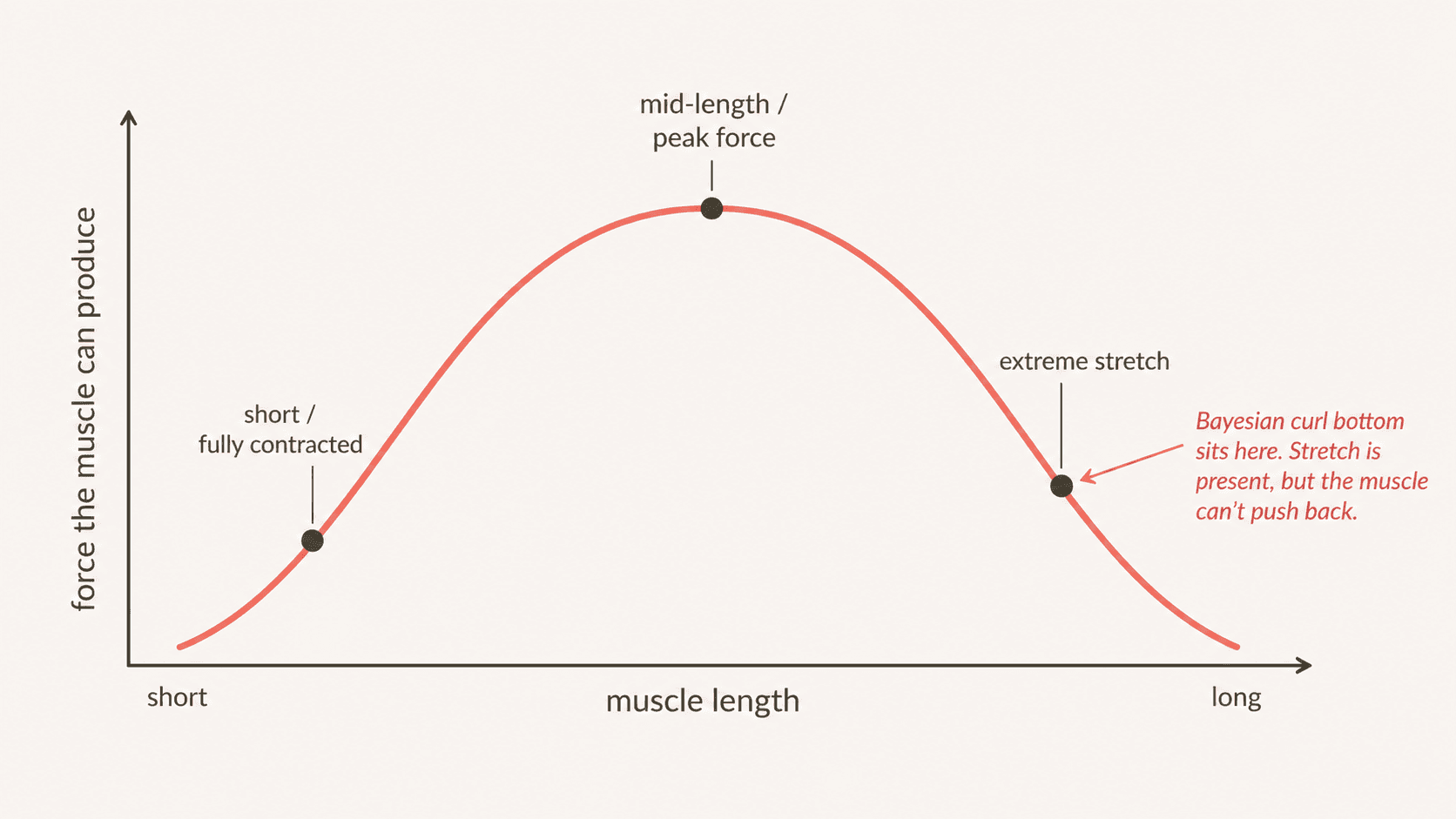
There are two reasons. The lengthened starting position is so extreme that it sits past the peak of the length-tension curve. Past that peak the muscle produces less force, so even with load present the muscle can't push back hard. The standing setup with a cable pulling diagonally forward also shifts a lot of the demand onto stabilizers. Both effects compound.
The takeaway: stretch isn't unbounded. You can over-stretch a muscle into a position where it can't generate force, and the growth signal drops with it. Stretch is real. It has a ceiling.
How to Pick Any Exercise
Two questions, in this order. Is the muscle biarticular, or is it calves? If yes, the exercise should put the muscle into its lengthened position. The implement matters less than getting the muscle long with some meaningful tension. Don't worry about whether the profile is perfectly heavy at the bottom; it usually isn't, and that hasn't stopped these exercises from working.
Is the muscle mono-articular and the lengthened position not really available? Look at the resistance profile. Pick the exercise that puts the heaviest load where the muscle can produce most force. For most mono-articular muscles that's the lengthened-to-mid range. For glutes it's the short range. The implement matters a lot here, because cable angles and dumbbell geometry change the profile dramatically.
Triceps long head. Cable overhead extension or dumbbell French press. The point is the overhead position. Pushdowns keep the triceps short across the whole rep, so they leave the long head undertrained.
Biceps. Incline curl or hammer curl. The point is the shoulder extended (long head lengthened). Standing curl works for short-head, but the shoulder position matters more than the implement.
Pecs. Dumbbell bench, deficit barbell bench, or cable fly. Stretch coverage is what matters most. Standard barbell bench cuts off the bottom of the stretch when the bar hits the chest.
Quads (rectus femoris specifically). Leg extension. The squat trains everything else but doesn't lengthen the rectus femoris, because the hip is flexed.
Side delts. Cable lateral raise from behind the body. Profile is the whole story. The dumbbell version is mostly empty load through the first 30 degrees.
Glutes. Hip thrust or 45-degree back extension. Profile heaviest where the glute is strongest.
Calves. Standing calf raise, deep ROM, pause at the bottom. Pure stretch case.
Hamstrings (the bonus case where both levers stack). RDL or deficit RDL. Heavy at the bottom, hamstrings stretched at the bottom, both mechanisms running at once.
When no exercise in your gym gives you a good profile in the lengthened position, lengthened partials are the workaround. Force-load the underweighted part of the ROM by doing partial reps from the bottom only. Useful patch, not a strategy.
How GainsLog Keeps You Honest
Once you've changed your exercise selection, you need a way to know whether the new picks are doing what they're supposed to. The framework is theory. Strength on the new exercises over time is the test.
GainsLog tracks every set of every exercise across every session. Swap pushdowns for cable overhead extensions and watch whether the overhead load climbs month over month; if it does, the new exercise is loading the muscle and the muscle is responding. Swap dumbbell lateral raises for behind-the-body cable raises and check whether the cable load goes up while your shoulders visibly broaden. If a swap doesn't move, either the technique is off, the volume is wrong, or the swap wasn't actually better for you.
The point of the framework isn't faith in either lever. It's having a small enough number of variables to test.