 GainsLog

Should I Bulk or Cut? A Decision Framework (and Why the Surplus Matters Less Than You Think)
Two variables decide the answer: body fat and whether you're still a novice. Three answers come out of those two inputs: cut, bulk, or recomp. The trap is that most lifters pick the phase that matches what they want to look like rather than what their body actually is, and then run the wrong phase for six months.
Table of Contents
You stand in front of the mirror with your shirt off, see narrow shoulders and a soft midsection, and decide that what you really need is to bulk. Six months of forcing food later, you're heavier, your waist is two inches bigger, and the shoulders still look the same. The bulk wasn't the problem. The decision to bulk was.
The bulk-or-cut question has a defensible answer that takes about ninety seconds to figure out. The reason most lifters get it wrong isn't that the framework is hard. It's that the answer the framework gives is usually different from the answer they were hoping for.
The Two Variables That Actually Decide
Body fat is the first variable. Training experience is the second. That's the whole input layer.
Andy Morgan puts it cleanly: it's not as simple as cut if you're high body fat, bulk if you're not. There's an interaction with how much training experience and muscle mass you have. The two variables together produce one of three answers: cut, bulk, or recomp. Nothing else.
Training experience here means whether you're still making linear progress session to session, not how many years you've been lifting. If you can still add a rep or a kilo on most lifts most weeks, you're a novice for the purposes of this decision, regardless of how long you've been training. By that definition, a lot of self-described intermediates are still novices, and a lot of the advice they're following was written for people further along than they actually are.
The Decision
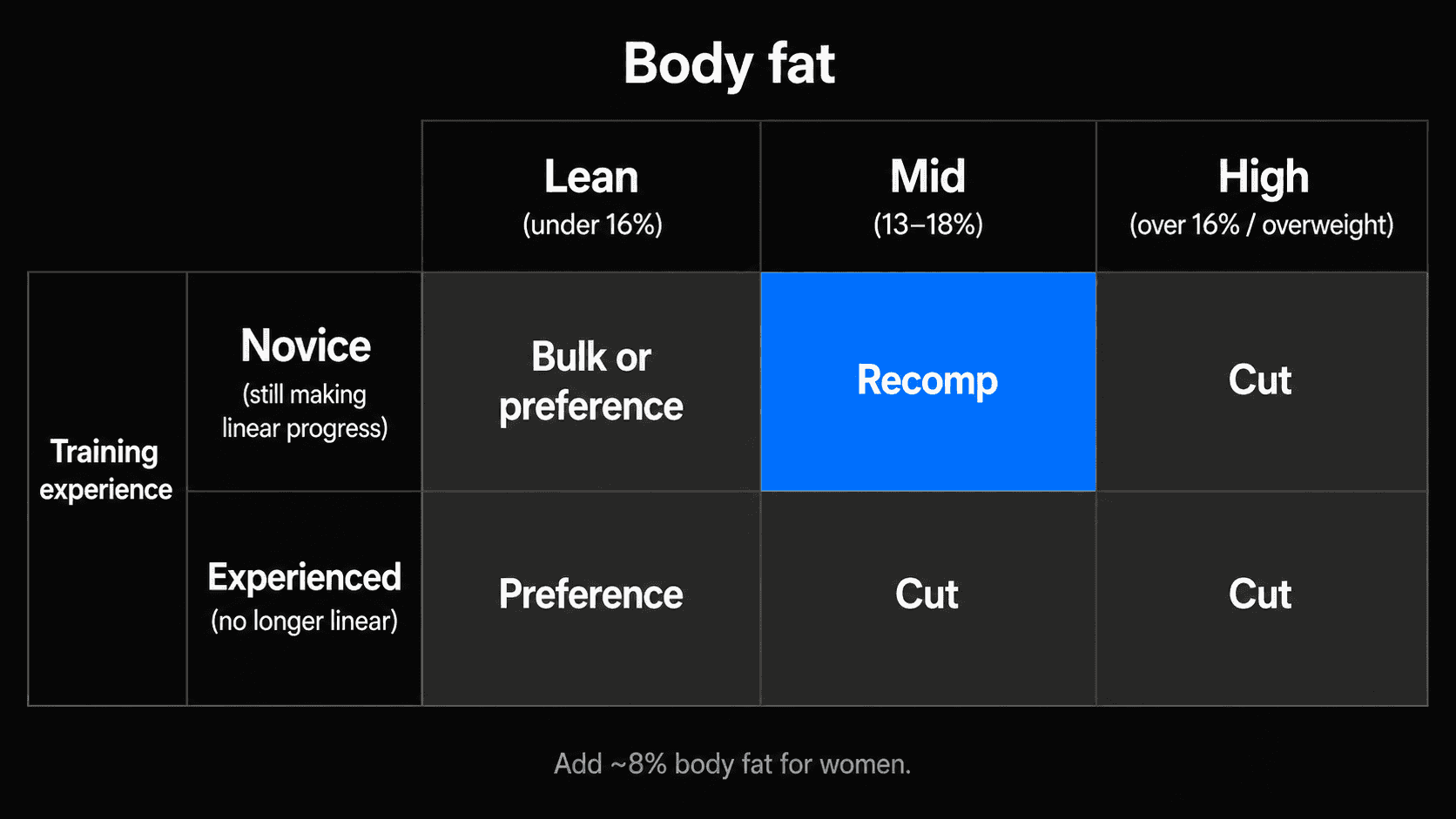
If you're overweight, cut. Training experience doesn't change this. You'll lose fat and, if you're new enough, gain some muscle while you do it. Either way, the path forward is down.
If you're underweight, bulk. Same logic in reverse. You don't have enough mass to look the way you want to look, and the phase that adds mass is the one that solves it.
If you're a novice in the 13 to 18 percent body fat range (skinny-fat territory), recomp at maintenance calories. Your untrained tissue responds strongly enough to a real strength stimulus that you can lose fat and build muscle at the same time, and you don't need the surplus to do it. This is the phase most ambitious beginners skip because the scale doesn't move much, but it's the one that actually fixes the body composition problem they're trying to solve. Within the skinny-fat band, the rough rule is: if you're on the leaner side, run a slight surplus and aim for around 1 percent bodyweight gained per month. If you're on the softer side, run a slow cut at slower than 0.5 percent bodyweight per week. (More on this in the dedicated skinny-fat article.)
If you're an experienced lifter over 16 percent body fat, cut. The recomp window is closed for you, the gains are slowing, and getting leaner first will set up a more productive bulk later.
If you're an experienced lifter under 16 percent body fat, it's preference. Both phases will work. Pick the one whose conditions you can actually meet, which is what the next section is about.
Add roughly 8 percent body fat to all of those numbers if you're a woman. Essential body fat is higher, the entire scale shifts up, and the same decision logic applies on a different baseline.
The Readiness Test (the part most frameworks skip)
The matrix tells you what phase your body is asking for. It doesn't tell you whether you're ready to run that phase. This is the part Mike Israetel hammers on, and it's where a lot of perfectly correct decisions still fall apart.
Bulk readiness has two components. Body image needs to be in a place where adding a little fat won't break you. Training fatigue needs to be low. Joints feel good, sets feel snappy, you're hungry to be in the gym. If you're still puffy from a long cut and the thought of gaining a kilo makes you anxious, the bulk will fail not because the calories are wrong but because you'll cut it short the first time you don't like the mirror.
Cut readiness has two components too. Diet fatigue needs to be low. You should be able to honestly say you're at peace with your food, that snacks are fine but you can do without them for a stretch. And you need a clear, low-chaos timetable. Eight to twelve weeks where weddings, travel, and high-stress work weeks aren't sitting in the middle of the cut. If you start a cut already starving, you fall off the wagon by week three. If the calendar is a minefield, you fall off by week five.
When the matrix says bulk but you're not ready, or says cut but you're not ready, don't grit through the wrong phase. Spend a few weeks at maintenance first to fix the readiness gap. Maintenance is the bridge that makes the next real phase work.
The Twist: the Surplus Matters Less Than You Think
All of that quietly assumes you need a calorie surplus to grow. Newer evidence isn't sure you do.
A 2021 meta-analysis by Murphy and Koehler found that cutting reduces muscle growth but not strength development compared to bulking. Your lifts will keep going up in a deficit. Muscle growth is harder, but it doesn't stop, and as Menno Henselmans points out, the effect is overestimated. The myth that muscle growth is only possible in a surplus is just a myth.
A separate six-month strength study divided people into low, medium, and high body fat groups, ran them all on the same program, and found no difference in muscle growth between the groups. Strength might suffer a little at higher body fat. Muscle growth holds up. The old idea that you need to be lean enough to bulk because high body fat impairs the response is shakier than it used to be.
Elijah Mundy puts the implication in plainer language: bulking isn't what's building muscle. Strength training is. Your calorie intake fluctuates throughout the week anyway. The two things that matter are fueling well enough to train hard and not getting fat. Keenan Malloy is even sharper: ask anyone who insists you need a surplus to maximize muscle growth why, and they can't tell you why. There's no mechanism that requires it.
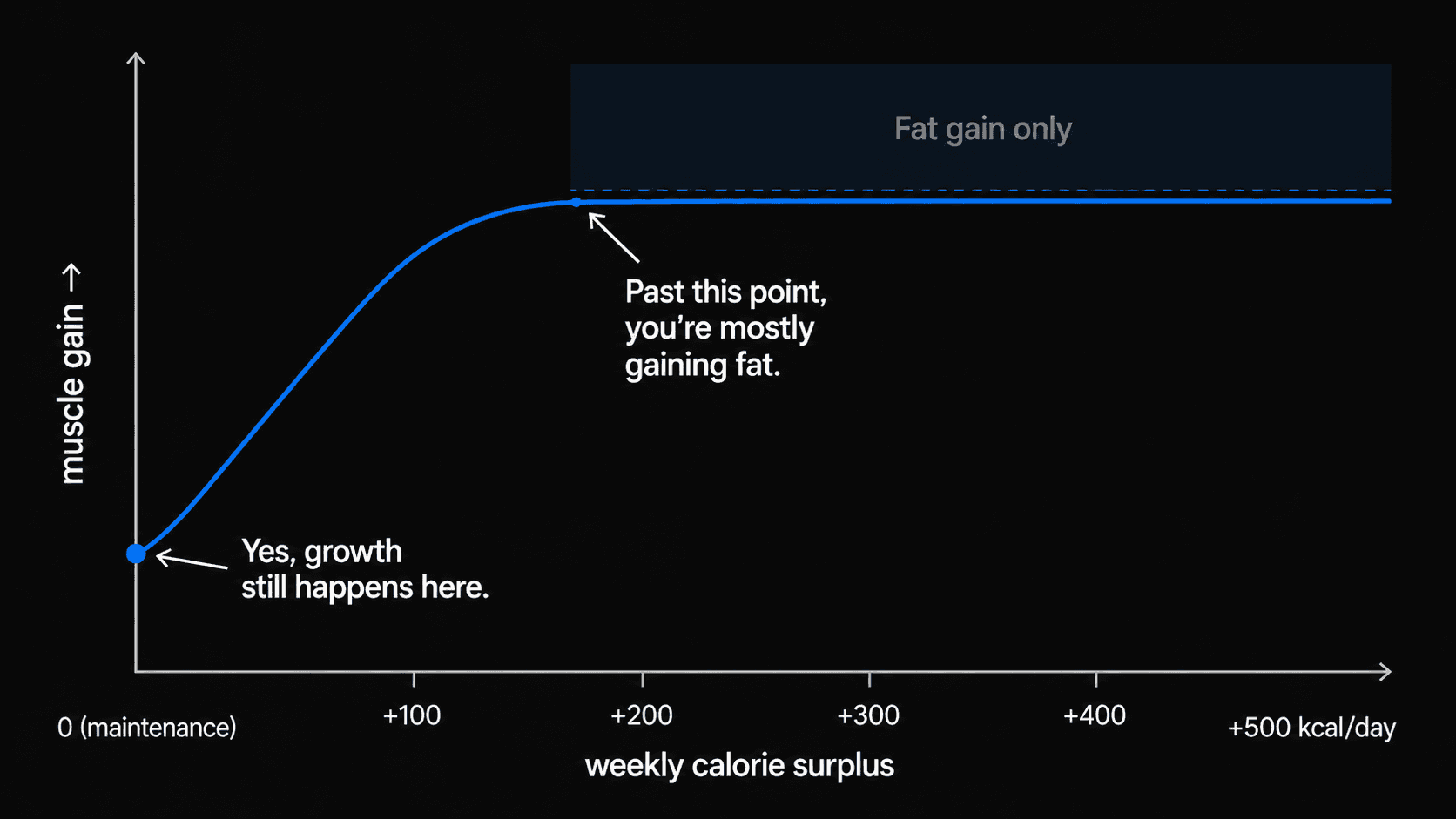
This doesn't mean a surplus is useless. Calories help recovery. Calories help performance. There's a personal version of this story I keep coming back to: an elbow injury I dragged through an entire cutting phase, that wouldn't budge no matter how I rehabbed it, was visibly better one week into a bulk. The body was telling me I'd been undereating. So the surplus matters. It just doesn't have to be aggressive. The shape of the dose-response curve flattens fast.
What This Means in Practice
Bulk smaller and longer than feels exciting. Around 1 percent of bodyweight per month is the classic guidance. Andy Morgan recommends a five-month minimum so you don't keep interrupting the anabolic process before it produces anything. Aggressive bulks are mostly fat, and the cut afterwards eats the calendar that should have been muscle-building time.
Don't bulk past the point where you've lost your abs. Not for muscle growth reasons (the body fat study above suggests that's not really an issue) but for health and quality of life. Roughly 20 percent body fat is the upper limit. Most people will want to stop sooner.
When you cut, drop your training volume by 20 to 33 percent. A calorie deficit is a recovery deficit, and the volume that was productive on bulking calories will run you into the ground on cutting calories. Henselmans's rule of thumb here is well calibrated: pull back roughly in proportion to how aggressive the deficit is. There's even a Ramadan study where athletes gained strength faster after cutting volume by 22 percent during fasting than they did when they kept their previous volume.
Walk-first cutting is worth knowing about. Instead of dropping food hard, keep food close to maintenance and push your steps to 15 to 20 thousand a day. The deficit comes from the activity rather than the plate. Gym performance holds up better because you're eating more, weight loss is more pure fat (less of the immediate water and glycogen drop), and walking has the lowest barrier to entry of any cardio. The 10,000 step number is a marketing target. The mortality benefits flatten out around 7 to 8 thousand. For cutting, more is fine.
You don't need to bump your protein up when you cut. The widespread rule that protein requirements increase in a deficit isn't supported by direct research, and the research that exists points the other way. The same 1.6 to 2.2 grams per kilogram of bodyweight that worked on a bulk works on a cut.
Use gym performance as your check during a cut. If the lifts are holding or going up, you're keeping muscle. If the lifts are crashing, the deficit is too aggressive, the duration is too long, or some combination of fat, omegas, protein, or carbs is too low. Adjust before muscle leaves with the fat.
The Most Common Mistake by Category
The lifter who feels small. Looks in the mirror, decides to bulk, often turns out to be skinny-fat. The right move was a recomp first, then earn the bulk. Bulking on top of skinny-fat just produces fat-skinny-fat.
The lifter who thinks they're stuck. Scale stalled, reach for the surplus. By Andy's definition (still making linear progress?) they're often still a novice, and a recomp is the answer rather than a bulk. The surplus they're chasing is solving a problem they don't actually have.
The lifter who just finished a cut. Eight weeks of restriction, immediate jump into a surplus. Skips the maintenance bridge and runs a bulk on top of high diet fatigue. It feels miserable, they cut it short, and they never give the bulk enough runway to do its job.
The lifter who refuses to ever go above 12 percent. The Mundy and Malloy stay-lean philosophy isn't wrong, but it's also not licensing you to never feed properly. If you're rejecting bulks because you don't want to gain any fat, you're capping the rate at which you can grow. The synthesis is small surpluses for longer phases, not skipping the surplus entirely.
The lifter who's been bulking for over a year. Started at 14 percent, drifted past 20 percent, never reset. The health risks past that line are real and the cut to come back is going to be longer than the bulk should have been.
How GainsLog Helps You Stay Honest
Every step of this framework leans on one signal: are your lifts going up? The recomp works as long as the bar moves. The cut works as long as performance holds. The bulk works when the surplus turns into measurable gym progress instead of just measurable fat. None of that is visible without a record.
GainsLog tracks your progressive overload session by session, so you can see whether the phase you picked is doing what it's supposed to do. If you bulked and the lifts didn't accelerate, the surplus didn't buy you anything and it might be time to pull it back. If you cut and the lifts kept rising, you nailed the deficit. If you recomp'd and you're squatting more for the same reps three months in, the recomp earned you the bulk.
The tools built around scale weight and calories are optimized for weight loss. They tell you what your body weighs. They don't tell you what it's becoming. The decision between bulking and cutting only makes sense if you can see the second thing.