 GainsLog
Why You Should Track Your Workouts (And What Happens When You Don't)
Progressive overload is the only signal that your training is producing results. Tracking is the only way to see that signal. Without a log, you're blind to both progress and plateaus.
Table of Contents
You finish three sets of bench press. It felt heavy. You're sweating. You go home satisfied. But did you actually lift more than last Tuesday?
Most people can't answer that question. They train consistently and push themselves. But they have no system to confirm whether their effort is translating into adaptation. They're working hard with their eyes closed.
You Don't Know How Hard You Train
Training hard is uncomfortable and subjective. A set can feel brutal without being close to failure. The burn and the pump create a sense of effort that doesn't necessarily correlate with productive stimulus.
Research consistently shows that even experienced lifters overestimate their proximity to failure. When tested in a lab, people who say they're at 3 reps in reserve are often closer to 5 or 6. For leg exercises, initial sets, and higher rep ranges, the gap is even wider.
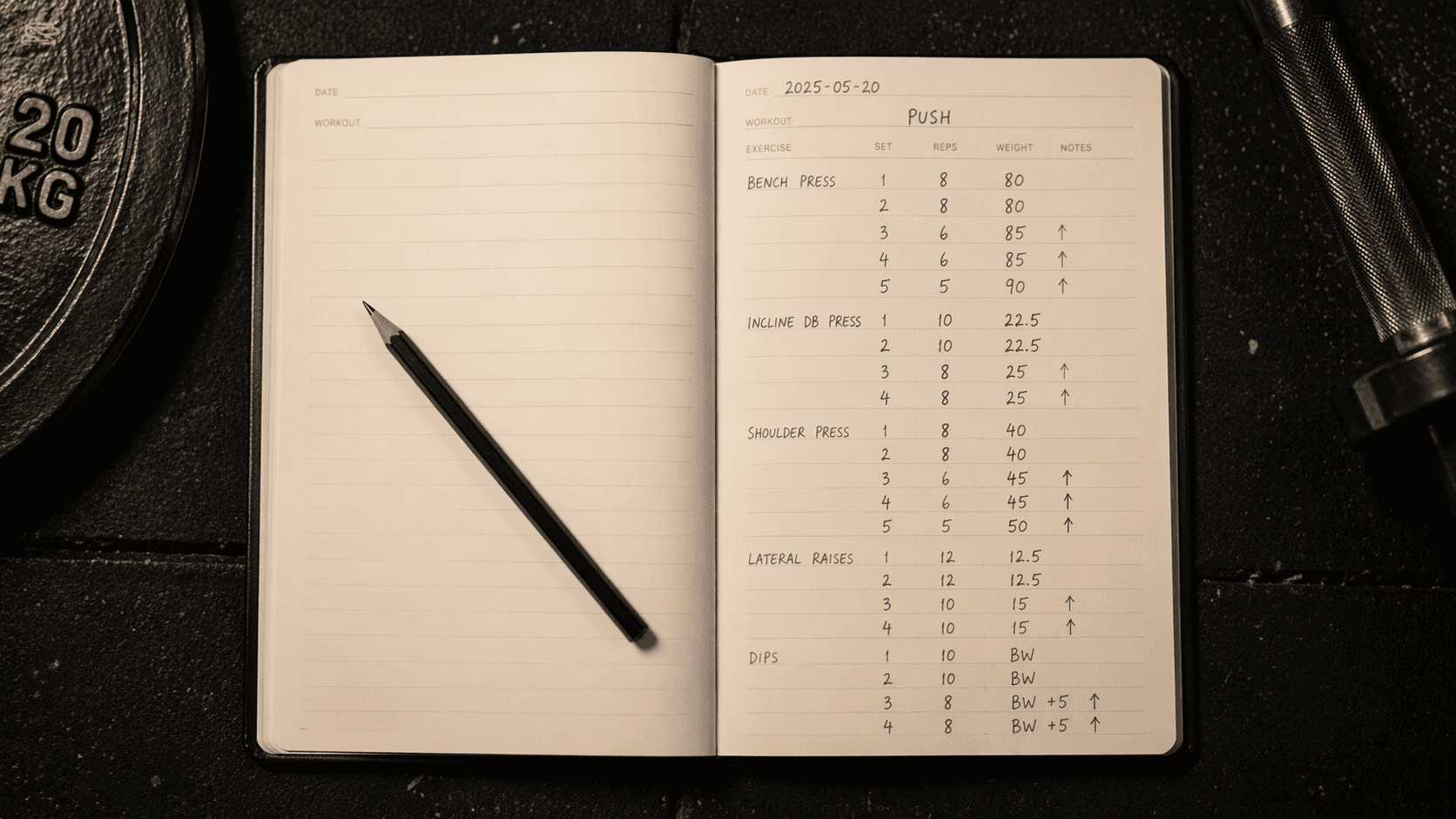
Numbers cut through this. Not as targets to chase blindly, but as reference points to compare against. If you bench pressed 80 kg for 8 reps last Thursday, you have a clear benchmark. Did you match it? Beat it? Fall short? Without that data point, you're relying on how the set felt. And how it felt is unreliable.
Having numbers to strive for demands that you actually train hard. Numbers also let you assess whether your process is working. Both are necessary for long-term progress.
Progressive Overload Is the Proof, Not the Method
Most fitness content frames progressive overload as a prescription. Add weight to the bar. Add a rep. Do more than last time. That framing leads people to think progressive overload causes muscle growth.
Progressive overload is the observable result of adaptation. You trained hard enough, recovered well enough, and your body responded. The proof is that you can now do more than before.
That reframe changes what you pay attention to. Instead of asking "how do I add weight to the bar," you ask "is my program producing adaptation?" Progressive overload becomes the diagnostic, not the goal.
If progressive overload is happening, your program works. Don't change it. Don't switch to something fancier. Don't add volume because someone online told you to. Keep grinding.
If progressive overload is not happening, something needs to change. Effort, volume, recovery, nutrition, or the program itself. But you can only know which one if you have data to diagnose the problem.
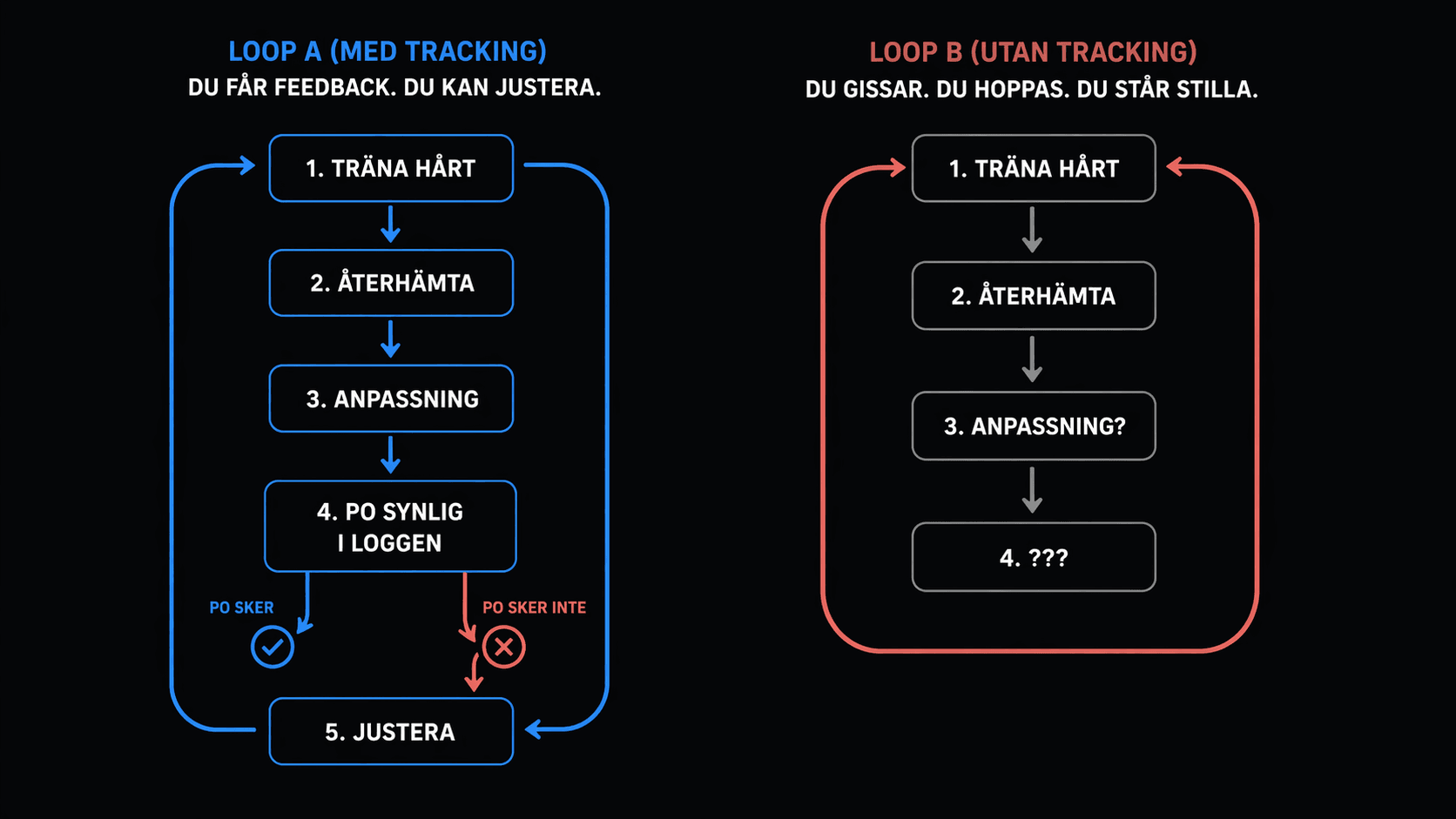
The flowchart above shows the difference. With tracking, you have a complete feedback loop: train, recover, check whether adaptation happened, and adjust if it didn't. Without tracking, the loop is broken. You train, you recover, and you go right back to training with no idea whether the last cycle produced anything.
What You Can't See Hurts You Most
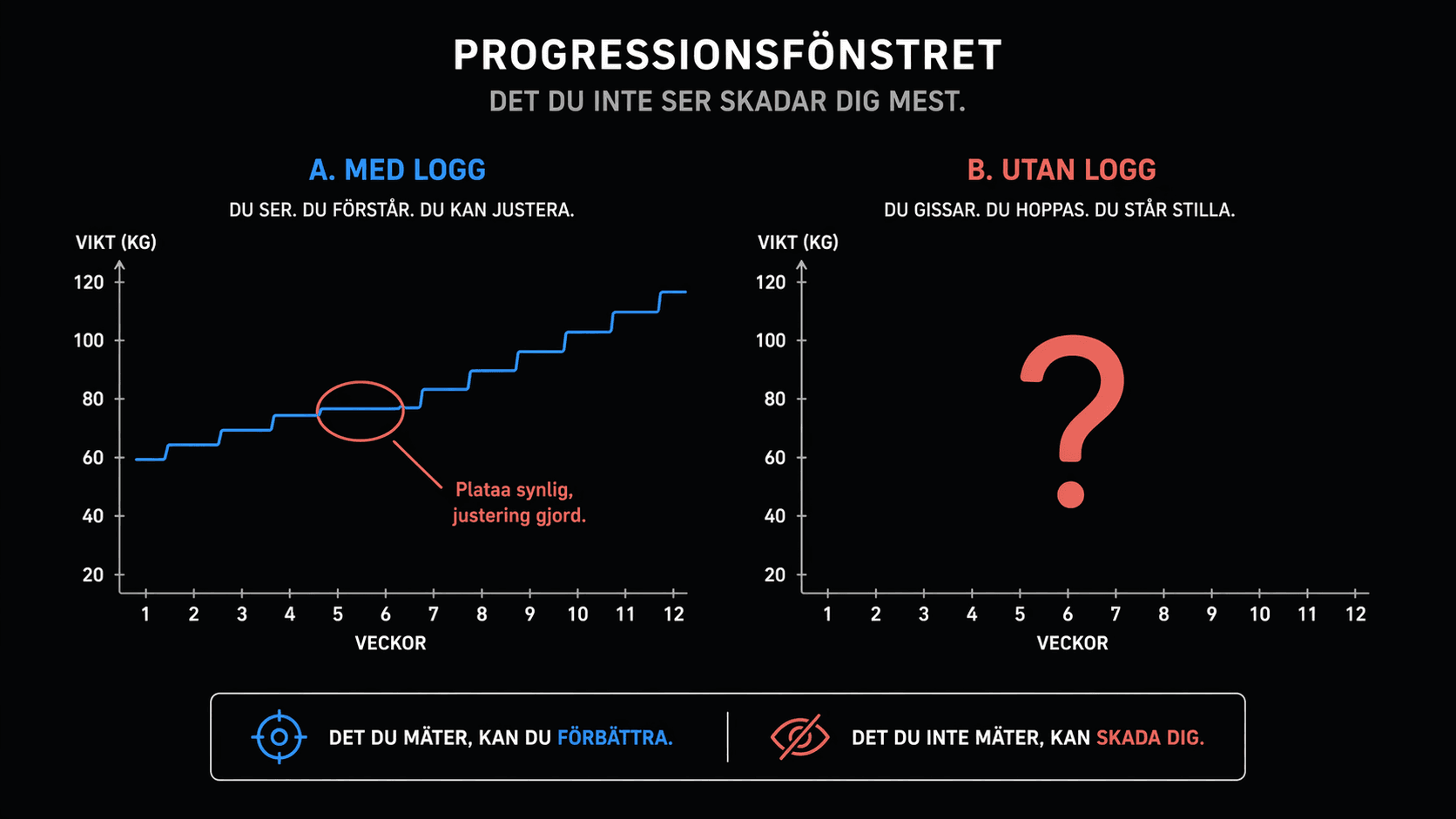
Without tracking, you can't tell the difference between a productive month and a wasted one. You show up, you train, it feels like you're working. But you have no feedback signal to confirm or deny it.
A common symptom: programs with fixed weights written in. "3x10 at 50 kg." If you can hit the rep target at that weight, the weight needs to go up next session. A program should never have predetermined loads. That's a recipe for repetition without progress.
Another symptom: program hopping. When things feel stale, the instinct is to switch programs. New exercises, new split, new rep scheme. But switching destroys the data trail. You can't compare your bench press from program A to your incline dumbbell press from program B. Instead of diagnosing why overload stalled, you erase the evidence and start from scratch.
The pattern is common: high effort, low structure, inconsistent results. You train hard, you care about getting stronger, but without a system to capture what's happening session to session, your effort doesn't compound. It just repeats.
Don't Change Exercises Every Week
You can't measure progressive overload if you swap exercises constantly. Tracking requires comparability. Last week's flat bench versus this week's flat bench. Last week's RDL versus this week's RDL. If one of those exercises changes, the comparison breaks.
A study by Baz-Valle and Schoenfeld compared fixed exercise selection to randomly varied exercises in trained men. Both groups did the same number of sets and trained to failure. The fixed-exercise group achieved better gains across the board. Muscle growth in the quads was roughly 350% greater for one of the measured heads.
The likely reason: with fixed exercises, you can monitor progression and implement overload. With random variation, every session is a fresh start. "Muscle confusion" doesn't just fail as a growth strategy. It actively prevents you from knowing whether you're improving.
This doesn't mean you should never change exercises. It means you should keep the same ones long enough to build a meaningful data trail. Four to six weeks minimum. Preferably longer.
The Log Isn't Perfect (But It Still Wins)
There's a real objection to logging workouts. Sometimes people chase the numbers and force reps they didn't earn. Technique degrades, the stimulus-to-fatigue ratio drops, and the set that looked good on paper actually made things worse.
So dial the weight back when that happens. Clean up form and build back up. You end up at a higher level each time. The short-term step backward produces a longer-term step forward.
Logging isn't black and white. You don't need to track every metric, every session, every variable. But a log gives you two things nothing else can: a target to aim for and data to assess whether your process is on track. Without either one, progress stalls over months and years.
What to Do About It
Pick a method. App, spreadsheet, notebook. The method matters less than the habit. What matters is that you write down the exercise, the weight, and the reps. Every session.
Stick with the same exercises long enough to compare. At least four to six weeks before rotating anything. You need a data trail to draw conclusions from.
After each session, compare against the last one. Did you add a rep? Add weight? Match the previous performance? If you did, the program is working. If you didn't, that's information. Not a failure, a signal.
When progression stalls, don't change the program first. Check effort, sleep, and nutrition. The program is the last thing to adjust, not the first.