 GainsLog

How Many Sets Per Week Do You Actually Need? Fewer Than You Think
Intensity is the prerequisite. Volume is the lever you pull once effort is real. 6-12 genuinely hard sets per muscle per week, spread across at least two sessions, is where most people should live.
Table of Contents
The internet has strong opinions about how many sets per week you should do. The science-based crowd says 10-20. Some researchers push for 30 or higher. Minimalists argue 8 is enough. Both sides have data behind them. And both sides are arguing about the wrong thing.
Training volume only matters once intensity is locked in. If you're not training hard enough, no number of sets will save you. Once you are training hard enough, you need far fewer sets than most people think. The practical range is tighter than the debate suggests, and the floor is lower than anyone on Instagram will admit.
None of It Matters If You're Not Training Hard Enough
This is the prerequisite that most volume discussions skip entirely. When researchers measure training volume, they count hard sets. That means sets taken within 0-2 reps of failure. Not warmups. Not sets where you stopped because the number on your program said to.
If your sets aren't close to failure, you could do 30 of them per week and barely grow. A set that ends 10 reps from failure produces a fraction of the growth stimulus compared to a set taken to 1-2 reps in reserve. This is true regardless of how heavy the weight is.
Most people count sets by what they wrote down. Three sets of bench, three sets of incline, three sets of flyes. Nine sets of chest. But if those sets ended comfortably, with reps still in the tank, the real number of productive sets might be closer to zero. Volume is measured in effort, not in logbook entries.
The problem is that most people overestimate how hard they train. Even competitive lifters, when tested in a lab setting, can typically squeeze out at least one more rep than they thought possible. If you think you're 3 reps from failure, you might actually be somewhere around 10. At that distance from failure, the number of sets barely matters.
This also explains why some high-volume studies show such positive results. Many subjects weren't training particularly hard on any given set, so they needed more total sets to accumulate enough stimulus. When a study claims that moderately trained university students performed 16 sets of squats per week to true failure, that claim deserves skepticism. When real effort per set goes up, the number of sets required comes down.
The Minimum Bar Is Lower Than You Think
You can make meaningful progress on as little as 2 hard sets per muscle per week, spread across 2 sessions. One genuinely hard set, twice a week. That's enough for measurable growth.
This won't maximize anything. But it will produce results. Even single-set protocols show hypertrophy when intensity is real. Two things are true at the same time: more volume produces more growth, and very little volume still produces some growth.
This matters for two reasons. If your time is limited, a few genuinely hard sets still move the needle. And it tells you where the floor actually is. If 2 hard sets per week generate growth, then 8 hard sets aren't barely scraping by. They're well into productive territory. The anxiety about hitting some minimum of 15 or 20 sets per week is unfounded when every set you do is actually taken close to failure.
More Sets Help, but Each One Is Worth Less
Once intensity is locked in, more hard sets per week does produce more growth. The dose-response relationship is real. Volume overall is a stronger driver of muscle growth than proximity to failure, assuming proximity to failure is already close enough for your sets to count.
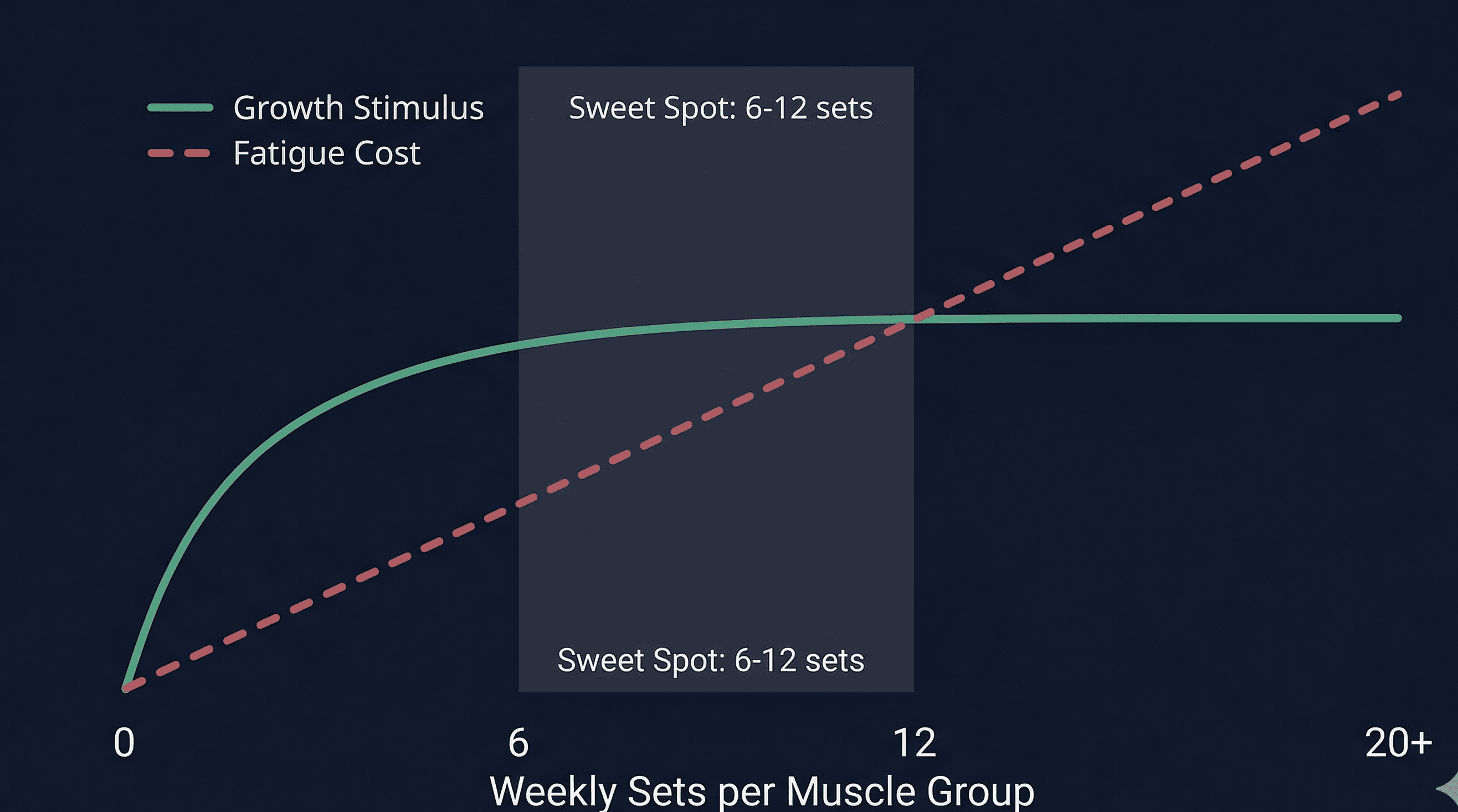
But the returns diminish steeply. Your first 6 sets per muscle per week do most of the work. Sets 7-12 add more, but noticeably less per set. Above 12, you're generating more fatigue than you're getting back in growth signal.
The chart above tells the whole story. Growth stimulus rises fast early, then flattens. Fatigue cost keeps climbing at the same rate. Around the 12-set mark, fatigue overtakes stimulus. Past that point, each additional set generates more recovery debt than growth. Progression slows, and the extra work actively works against you.
There are people who recover from and grow on 16+ sets per muscle per week. They exist. They're usually young, in a caloric surplus, sleeping well, and genuinely training every set hard. If that describes you and progression is happening at those volumes, there's no reason to cut back. But if you're adding sets because the number feels too low and your progression has stalled, the volume might be the problem, not the solution.
The practical recommendation: 6-12 hard sets per muscle per week. The lower end works well when intensity is genuinely high. The upper end gives slightly more stimulus if recovery supports it. Most people should land somewhere around 8-10.
You Can't Cram It Into One Session
Even if your weekly volume is reasonable, packing it all into one workout kills the benefit.
Research points to a per-session ceiling of roughly 10 sets per muscle group. Beyond that, muscle protein synthesis stops increasing while fatigue and muscle damage keep stacking. Studies where 15-20 sets per week produced worse results than 10 sets? Those subjects trained each muscle only once per week. They weren't overtrained on volume. They were undertrained on frequency.
The studies showing benefits at 30-45 sets per week all used 3x weekly frequency, keeping per-session volume around 10-15 sets. The weekly total was high. The number that actually matters, per-session volume, was reasonable.
A useful per-exercise rule: cap any single movement at 3 working sets per session. After 3 hard sets of the same exercise, the stimulus from additional sets drops off sharply. If you have more volume to do for that muscle, switch to a different angle or resistance profile. Two exercises at 3 sets each will outperform one exercise at 6 sets.
This is where frequency becomes the delivery mechanism. If you want 10 weekly sets of chest, that's 5 per session across 2 sessions. If you're doing 12, that's 6 per session at 2x frequency. Keep per-session volume under 10, and train each muscle at least twice per week. The traditional bro split, where each muscle gets hammered once per week with high session volume, is the worst setup for this math.
What This Looks Like in Practice
Say you're doing 10 sets of chest per week.
Option A: once per week, all 10 sets on Monday. Flat bench 4x6. Incline dumbbell press 3x8. Cable flyes 3x12. By set 7 or 8, fatigue is stacked and motor unit recruitment is degraded. The last sets feel hard, but feeling hard and being productive are different things when systemic fatigue is high. You leave the gym wrecked. Recovery takes days. You don't touch chest again until the following Monday.
Option B: twice per week, 5 sets each session. Monday: flat bench 3x6, low-to-high cable fly 2x10. Thursday: incline smith press 3x7, pec fly machine 2x10. Per-session volume stays well under the ceiling. Two different angles and resistance profiles across the week. Each set is productive because you're relatively fresh. Recovery between sessions is manageable, which means you can actually push for progression on Thursday instead of just surviving it.
Same 10 weekly sets. Completely different outcomes. Option B grows more muscle because every set generates real stimulus, and you recover well enough between sessions to add weight or reps the following week.
2x frequency isn't the only way. 3x works too, especially if per-session volume is lower at 3-4 sets per session per muscle. What matters is that every set lands in a range where it's productive, and frequency is high enough to distribute your weekly target without hitting the per-session ceiling.
Adjust for Your Life
Optimal volume isn't a fixed number. It shifts with your circumstances.
During a cut, reduce volume by 20-33% compared to what you do while bulking. An energy deficit means a recovery deficit. In a study on athletes during Ramadan fasting, they gained strength faster when they reduced volume by 22% than when they kept training at the same level. Less food means less recovery capacity. Maintaining bulking volume on cutting calories is how people stall.
Stress, sleep quality, and age all lower how much volume you can productively handle. The high-volume research was done on young men at universities with low-stress lives, usually in a caloric surplus. If you're working full-time, sleeping poorly, and in a deficit, your ceiling is lower. Be honest about that.
The check is simple: progressive overload. If you're adding weight or reps over time, your volume is working. Don't add sets because someone online told you to. If progression has stalled, volume might need to change, but sometimes that means less, not more. Start at the lower end, 6-8 hard sets per muscle per week at 2x frequency, and add only when progression stalls after ruling out intensity, recovery, and nutrition.
How GainsLog Helps You Get This Right
Volume is only useful as a training variable if you actually track it. Most people have no idea how many working sets per muscle they're doing per week. They guess, and they guess wrong.
GainsLog tracks sets per muscle group, so you see your real weekly volume instead of what you think you're doing. When progression stalls, that data lets you figure out why. Too little stimulus to drive adaptation? Or too much to recover from? Without actual numbers, both problems feel identical from the inside.
Progressive overload is the proof that your volume and intensity combination is working. If weights and reps are going up over time, your training is producing adaptation. Don't change anything. If they're not, you have data to diagnose the problem instead of blindly adding more sets and hoping for the best.