 GainsLog

Training to Failure vs RIR: How Hard Should You Actually Train?
The last reps are the ones that build muscle. Everything before them is just the price of admission. Most people should be training harder, not more.
Table of Contents
Most people who train 'to failure' are not close to it. And most people who use RIR to avoid failure end up training so far from it that the RIR number is meaningless. Both mistakes come from the same root: nobody actually knows where their failure point is.
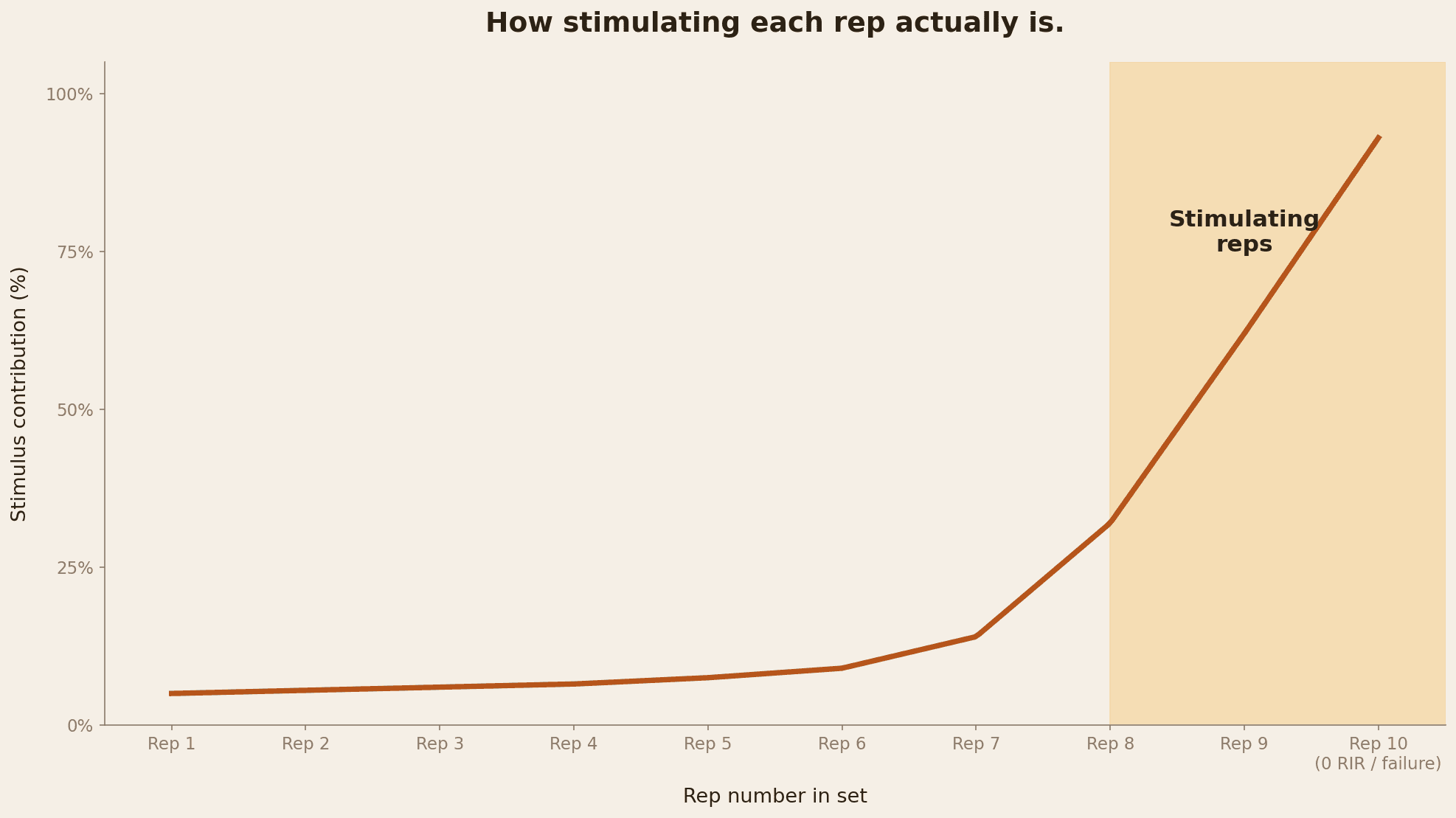
This matters because the last reps are the ones that do the work. Everything before them is just the price of admission.
The Terminology Problem
The debate about 'training intensity' never goes anywhere because the word means two different things and nobody agrees which one they're using.
Load-based intensity is the percentage of your one-rep max you're lifting. Effort-based intensiveness is how close to failure a set is. When someone says they 'train with high intensity,' they might mean they lift heavy or they might mean they push hard. Those are not the same thing, and the confusion is not trivial.
For this article, intensity means one thing: proximity to failure.
Failure itself is slippery as a target. There's genuine confusion about whether 0 RIR and 1 RIR even mean different things: you never truly know you couldn't get another rep until you fail. There's no way to be certain. You're estimating. Some coaches who train extremely hard haven't actually failed a rep in years. They stop at what feels like the edge. Sometimes the edge is accurate. Often it isn't.
The fuzziness of these definitions is exactly why the failure-versus-not-failure debate never resolves. People are arguing about something none of them can cleanly measure.
Why the Last Reps Are the Ones That Build Muscle
The reason proximity to failure matters comes down to motor unit recruitment. Your nervous system recruits motor units from smallest to largest based on how much force is required. The high-threshold motor units, the ones attached to the larger, more powerful muscle fibers, only activate when force demand is high enough to require them.
Stop the set before those high-threshold fibers are called into action and they don't get a growth stimulus. They just watched.
This is why five-rep sets and twenty-rep sets can produce similar hypertrophy when both are taken close to failure. The stimulating reps happen at the tail end of every set regardless of load. With heavier loads, full recruitment happens early because the force demand is immediately high. With lighter loads, smaller motor units fatigue progressively, and the larger ones are forced into action as the set approaches failure. The path is different. The destination is the same.
Low-load training only produces meaningful muscle growth when taken to failure. Without failure as the endpoint, the high-threshold fibers never get recruited. You did cardio.
The Calibration Problem
This is where most people's training breaks down. The direction of the error is almost always the same: people think they're closer to failure than they are, by a large margin.
The more common mistake is not going to failure too often. It's going too easy while believing you're working hard.
Research on RIR accuracy has found that even highly trained, competitive lifters can typically do at least one more rep than they thought possible when really pushed. If you think you're 3-5 RIR away, you might actually be closer to 10. Competitive lifters. People who train seriously for sport. Still dramatically miscalibrated on what hard actually is.
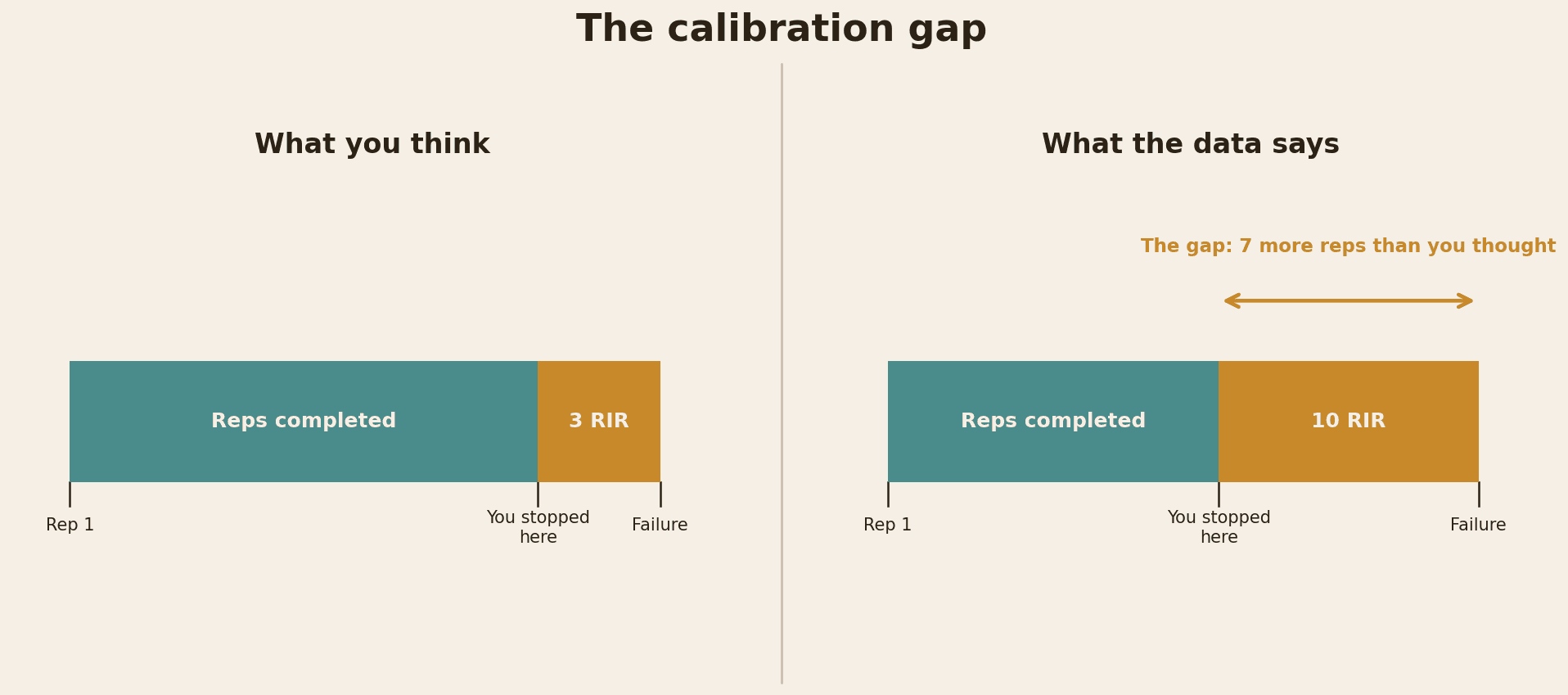
Miscalibration is worst in specific conditions: legs, early sets in a session, and high-rep work. One practical fix is to use lower rep ranges precisely because of this. If you misjudge by two reps on a set of six, you're at 2 RIR. The set was still hard enough to drive growth. If you misjudge by two reps on a set of twenty, you were at 12 RIR. The set was largely a waste of time. Low reps contain your error.
High reps compound the calibration problem in a specific way that's worth understanding. A two-rep miscalibration on heavy work is recoverable. On a high-rep set, that same two-rep error turns a productive set into something closer to light cardio. Research has found that sets of twelve can cause enough acute CNS fatigue that even landing at 2 RIR wipes out the benefit.
I ran into this directly during the 2024 summer cut. I was training full-body five times a week, roughly two sets per muscle per session, at 1-2 RIR throughout. Low volume by almost any standard. It produced the best hypertrophy I'd had during a cut. The low volume only worked because every set was actually hard. Not approximately hard. Hard. If the effort had been casual, two sets per muscle would have been nothing. The intensity is what made the volume count.
That's the core point. Volume and intensity are not independent variables you can trade off against each other without limit. At some proximity-to-failure threshold, the set stops contributing. You can't compensate with more sets that are also too easy.
Failure Has Real Costs
None of this is an argument to always train to failure. Failure has a cost, specifically to the other sets you're about to do.
Going to failure on early sets reduces the number of reps you can complete in later sets. If the goal is to produce more total reps, and going to failure early prevents you from completing reps later, you've lost the deal.
Multiple meta-analyses have found that training to failure only adds muscle growth when it increases total rep volume. The benefit is the extra reps, not something special about the moment of failure itself. Complete the same rep volume through submaximal sets and you get the same result.
Failure makes sense when you have one set for a muscle that week and need to maximize stimulus per set. With a full program, it's a cost-efficiency equation: does going to failure on this set make sense for the whole session? Genuine 0-1 RIR effort also makes recovery harder than most people expect. If going to failure on set after set feels manageable, ask whether you're actually going to failure.
What 0-2 RIR Actually Looks Like in Practice
The practical target for most working sets is 0-2 RIR. Failure is acceptable on the last set of an exercise, where the downstream fatigue cost disappears because there's nothing downstream.
In practice: 1-2 RIR for working sets, failure reserved for the last set only, rep ranges in the five-to-ten zone.
The case for staying in lower rep ranges goes beyond containing calibration error. Studies showing 'all rep ranges produce similar hypertrophy' are actually an argument in favor of lower reps. Fatigue accumulates faster at high reps. Over time, that fatigue will plateau your progress regardless of whether the stimulus is there. Lower reps are simply less fatiguing per unit of stimulus.
When to actually go to failure: one set for a muscle that week, take it to zero. The cost is limited and the need to maximize stimulus per set is real. In a full program with adequate volume, grinding to failure early rarely makes sense.
Most people should be training harder, not more. The sets they're doing aren't producing the stimulus they think they are. Getting the calibration right, which mostly means accepting that hard needs to feel harder than it currently does, is worth more than any rep range debate or periodization scheme. Find the edge. Train near it. Don't pretend you already are.
How GainsLog Helps
Knowing where your failure point is requires feedback over time. GainsLog logs every set with weight, reps, and RIR, so you can see whether you're actually progressing or just doing the same thing week after week.
If your logged weights and reps aren't moving, the most common culprit isn't volume. It's that the sets aren't hard enough. The data makes that visible instead of leaving you to guess.