 GainsLog
Best Rep Range for Muscle Growth: Why It Matters Less Than You Think
Lower reps aren't more effective per set. They're just a better deal, letting you sustain more productive volume, progress more consistently, and spend less time feeling beaten up.
Table of Contents
The internet loves a definitive answer. Low reps for strength, moderate reps for size, high reps for endurance. Clean categories, easy to follow, completely outdated.
The updated version isn't much more helpful: "rep range doesn't matter, just train hard." That's technically true. Research consistently shows that sets taken close to failure produce similar muscle growth whether you're doing 5 reps or 25. But telling someone "it doesn't matter" when they're standing in a gym trying to decide what to do is about as useful as telling someone lost in a city that "all roads lead somewhere."
Rep range might not matter for hypertrophy on a per-set basis. But it matters for fatigue, recovery, session quality, and your ability to actually progress over time. And those things determine whether your training produces results or just produces soreness.
"It All Works" (And That's True)
Let's get this out of the way: the research is clear. Sets taken close to failure produce similar muscle growth across a wide range of rep ranges, roughly 5 to 30 reps. This isn't controversial anymore. The data is consistent and the mechanism makes sense.
Muscle growth is primarily driven by mechanical tension. When you take a set close to failure, motor unit recruitment is high regardless of the load you're using. A set of 8 at 0-1 RIR and a set of 20 at 0-1 RIR both end up recruiting a similar number of muscle fibers by the end. The lighter set just takes longer to get there, because motor units are recruited from smallest to largest based on force demands. With a heavy load, you're near full recruitment from the first rep. With a lighter load, it takes until the last several reps for fatigue to force full recruitment.
This is real. It's not a technicality. If you enjoy higher rep training and it keeps you consistent, you can absolutely build muscle that way. Nothing in this article is saying otherwise.
But "it works" and "it's the best approach for most people in most situations" are different claims. And the gap between them is where the practical argument for lower reps lives.
The Range Everyone Lands On
If rep range truly doesn't matter, you'd expect experienced coaches to be all over the map. Some would program sets of 15-20, others would stick to 5-8, and the distribution would be random.
That's not what happens. When you look at coaches who actually build physiques, who have years of experience training themselves and others, they almost all converge on the same range. The recommendations cluster between 4 and 10 reps, with 6-8 being the most common sweet spot. Some go as low as 3-6 for their own training but still recommend 6-8 for most people. Others frame it as 80% of your sets should be under 10 reps.
The consensus extends to isolation work too. The old thinking was that compounds should be heavy and isolation should be lighter with more reps. But the coaches who get results program isolation in the same range as everything else. Sets of 6-8 on curls, lateral raises, tricep extensions.
The range varies slightly from person to person, but they all orbit the same zone. Nobody with extensive experience building muscle is programming sets of 20 as the backbone of their training. That should tell you something.
Higher Reps Are Actually Harder
This is the part most people get backwards. The assumption is that lighter weight means easier training. Pick up something lighter, do more reps, less stress on the body. Sounds intuitive. It's wrong.
When you equate exercise and relative intensity, higher reps are actually more fatiguing, not less. A set of 15 on deadlifts taken to 0 RIR is significantly harder to recover from than a set of 5.
If both sets are taken to the same proximity to failure, the set of 15 involves dramatically more total work. More muscle contractions, more metabolic byproducts, more time under load, more overall stress on your body. The last few reps might produce similar mechanical tension, but you had to grind through 10+ additional reps to get there.
The reason lower reps work better in practice is because they're physiologically easier. Not because the individual reps are more effective for growth, but because the total cost per set is lower. You get the same stimulus with less systemic fatigue.
This matters because fatigue isn't free. Every set you do costs something. And the currency isn't just how tired you feel right now. It's how much recovery capacity you've used up, how much your subsequent sets are degraded, and how ready you'll be for your next session.
The Problem Studies Don't Show You
Here's where the "rep range doesn't matter" finding starts to crack in practice.
Most studies comparing rep ranges use a single exercise. Sometimes two. They equate volume, have participants train to failure, and measure hypertrophy after 8-12 weeks. Under those conditions, the results are clear: similar growth across rep ranges.
But nobody trains like that. A real program has 4-6 exercises per session, 3-4 working sets each, spread across 3-5 sessions per week. Fatigue doesn't just affect the set you're doing. It bleeds into every set that follows.
Higher reps combined with multiple sets on taxing exercises compound fatigue in ways that studies simply don't capture. When you're four exercises into a session and you've been doing sets of 15, your motor unit recruitment is degraded whether you realize it or not. The set feels hard, maybe harder than it should. But "hard" and "productive" aren't the same thing. Perceived effort misleads people when fatigue is high.
This is also why capping working sets at around three per exercise per session makes sense. Beyond that, diminishing returns kick in hard. And if your rep range is already causing excessive fatigue, you hit that wall even sooner.
The question isn't whether a single set of 20 builds the same muscle as a single set of 8. It probably does. The question is whether your fifth exercise of the session, after 12-16 sets of high-rep work, is still producing a meaningful stimulus. The answer, increasingly, is no.
What a "Hard Set" Actually Costs
If training volume is best measured in hard sets, not total tonnage and not total reps, then there's a question worth sitting with: does a hard set of 6 reps equal a hard set of 25 reps?
On paper, maybe. Both are taken close to failure. Both produce high motor unit recruitment by the end. Both should produce similar hypertrophy in isolation.
But they don't cost the same. The set of 25 involves far more total work, generates more metabolic stress, causes more muscle damage, and demands more recovery. If you can do 15 hard sets per week for a muscle group before recovery becomes a limiting factor, and each of those sets is in the 6-8 range, you're accumulating 15 productive sets at a relatively low fatigue cost.
Switch those to sets of 20-25, and you might only be able to handle 10 before recovery breaks down. Same hard sets, fewer of them, because each one costs more.
Over weeks and months, this difference compounds. The lifter doing lower reps can sustain more productive volume, progress more consistently, and spend less time feeling beaten up. Not because their individual sets are more effective, but because each set is a better deal.
When Higher Reps Make Sense
None of this means higher reps are useless. There are specific situations where they're the better choice.
If you're training around an injury, higher reps can let you keep working a muscle without aggravating the problem. Below roughly 70% of your one-rep max, around 12 reps or more, connective tissue stress drops significantly. High rep training is genuinely underrated when it comes to injury management.
For older lifters, higher rep work is easier on joints and connective tissues. The stimulus-to-stress ratio shifts as you age, and lighter loads with more reps can be a smart way to keep building muscle without accumulating joint wear.
During deload periods, dropping the weight and increasing reps helps manage accumulated fatigue while maintaining training stimulus.
The point isn't to never do a set above 10 reps. It's that the majority of your training, the sets that form the backbone of your program, should live in a range that lets you do the most productive work over time. For most people, that's somewhere between 5 and 10.
Tracking Progression in the Right Range
Lower rep ranges also make progression easier to see and act on. When you're working in sets of 6-8, adding a single rep or 2.5 kg is a clear, measurable step forward. When you're doing sets of 20, the signal gets noisy. Did you do 20 or 22 reps? Was the form the same? Were you actually closer to failure or did you just push through more discomfort?
This connects directly to progressive overload as a diagnostic tool. If overload is how you know your training is working, you need to be in a rep range where small changes are meaningful. A jump from 60 kg for 7 reps to 60 kg for 8 reps is a clear signal. A jump from 30 kg for 22 reps to 30 kg for 24 reps could mean anything.
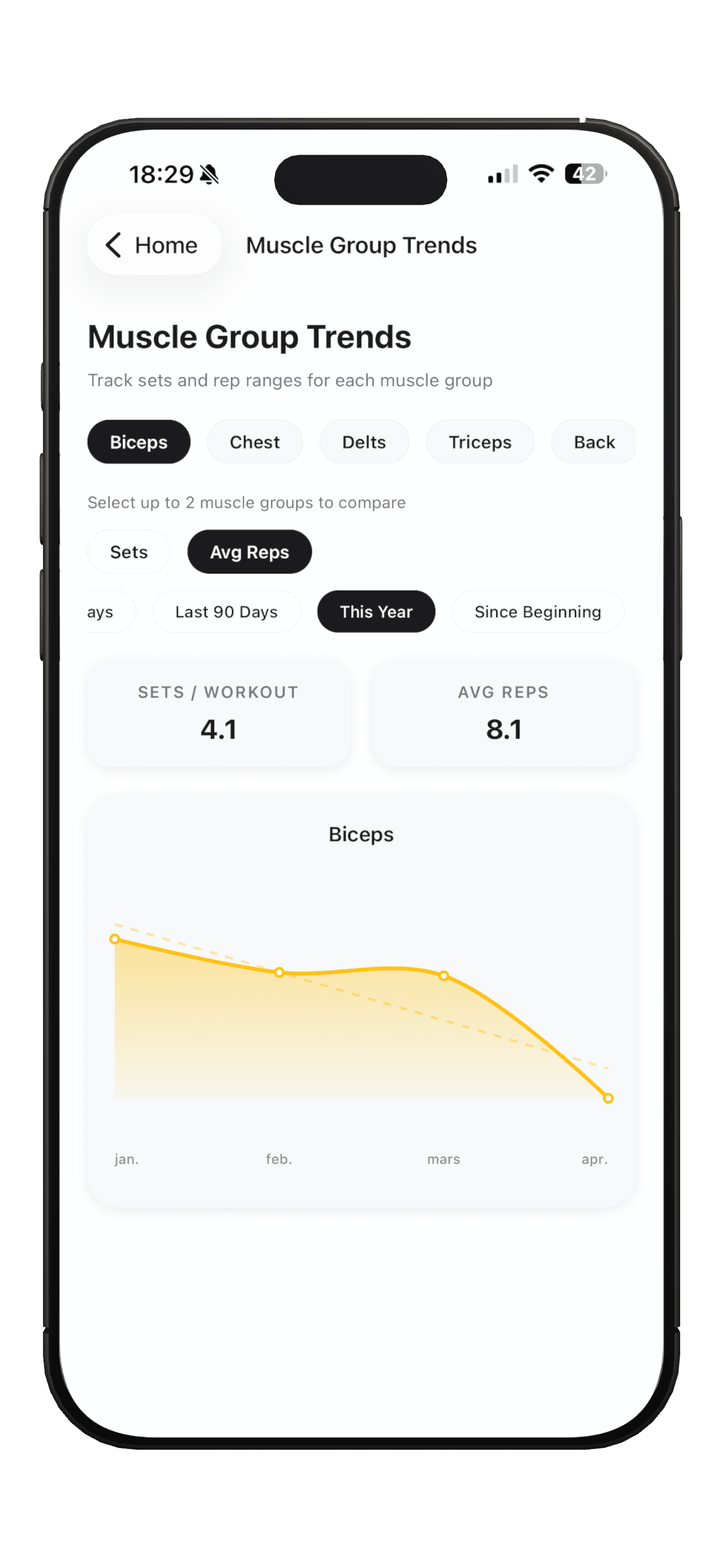
GainsLog is built around this principle. After every session, it evaluates your performance and sets targets for the next one. Hit your rep target, the weight goes up. Didn't get there, you keep the same load and push for more reps. Momentum tracking shows you whether your program is producing adaptation over time. All of that works best when you're in a rep range where each data point carries real information, where progress is unmistakable and plateaus are impossible to miss.