 GainsLog
What Is Progressive Overload? The Only Signal That Your Training Works
Progressive overload is the measure of your gains, not the cause. It proves your training worked. If it's not happening, something needs to change. If it is, don't touch a thing.
Table of Contents
You've heard it a thousand times: "just add weight to the bar." Every fitness YouTuber, every Reddit thread, every gym bro with a clipboard will tell you that progressive overload is the key to building muscle. Add 2.5 kg every Monday. Chase the numbers. Beat the logbook.
They're not wrong, exactly. But they're missing the point in a way that matters. Progressive overload isn't something you do to build muscle. It's the evidence that you already did. And that distinction changes everything about how you should train.
The Common Understanding (And Why It's Incomplete)
Most lifters are taught progressive overload as a prescription, a method you apply to your training. Add weight or reps every session. If you did 60 kg for 8 reps last week, do 62.5 kg this week, or squeeze out a 9th rep. The framing is always the same: progressive overload is something you do.
That framing leads to two failure modes. The first is forcing progression: ego lifting, breaking form, grinding out ugly reps to "beat the logbook." Sometimes when trying to beat the logbook people force it, rather than earn it. The second failure mode is feeling like you've failed when the numbers don't go up. You did everything "right" but the weight didn't increase, so you must be doing something wrong. Both of these are symptoms of treating the signal as the cause.
What Actually Causes Muscle Growth
Mechanical tension via training close enough to failure is the primary driver of hypertrophy. Training within 0-3 reps in reserve produces greater muscle growth than stopping far from failure, with 1-2 RIR being the practical sweet spot. Low-load training can work too, but only when taken to or very near failure. The common denominator isn't the weight on the bar. It's the effort relative to your capacity.
The second driver is sufficient volume of hard sets. There's a dose-response relationship between training volume and muscle growth, but only when those sets are actually challenging. If they're not close to failure, the entire equation falls apart. Practically, 8-12 hard sets per muscle group per week is a solid range for most lifters, not the 20+ set programs that are trendy online.
Here's the part that should reframe your thinking: when researchers compared rep progression (adding reps at the same weight) to load progression (adding weight at the same reps) over 8 weeks, the result was equivalent hypertrophy. If how you overload doesn't matter, if adding a rep works just as well as adding a plate, then progressive overload itself isn't the mechanism driving growth. The effort is. The overload is just the proof that adaptation happened.
So What IS Progressive Overload?
Progressive overload is the observable result of adaptation. You trained hard enough, ate enough, slept enough, and your body responded by getting stronger. The evidence? You can now do more than you could before: more weight, more reps, or both. That's it. That's what progressive overload actually is: the receipt, not the purchase.
This isn't just semantics. It changes what you optimize for. Instead of asking "how do I add weight to the bar," you start asking "is my program producing adaptation?" The research consistently shows that hypertrophy tracks with proximity to failure, not with any specific overload protocol. The method doesn't matter. What matters is whether your training is hard enough and structured well enough for your body to respond.
If progressive overload is happening, if you're consistently able to do more over time, your program works. Don't change it. Don't hop to a new program because someone on Instagram said theirs is better. As long as the numbers are moving, you've found something that works for your body. Squeeze every last drop of progress from it before moving on.
If progressive overload isn't happening, if the weights have been stuck for weeks, something needs to change. Maybe you're not training hard enough. Maybe your volume is too low, or too high. Maybe your recovery or nutrition can't support the demands you're placing on your body. Progressive overload isn't a goal you chase. It's a check engine light. When it's on, everything is working. When it turns off, it's time to diagnose.
The Mistakes That Follow from the Wrong Mental Model
When you think of progressive overload as a method rather than a signal, you make predictable mistakes.
The first is writing programs with fixed weights assigned to exercises, like "3x10 at 50 kg" with no plan to increase. This is a huge red flag. A program should never have fixed weights baked in. If you can hit your rep target with a given weight, you need to increase that weight next session. Otherwise you're just maintaining, and plateaus are guaranteed.
The second is changing exercises constantly, thinking variation itself drives growth. The evidence consistently shows that fixed exercises beat so-called "muscle confusion" for gains. Why? Because progressive overload may be the greatest practical benefit of a fixed exercise selection: you can monitor your progression. When you rotate exercises every few weeks, you destroy the feedback signal. You can't tell if you're actually getting stronger because the measurement keeps changing.
The third is program hopping: switching programs every time progress feels slow instead of diagnosing why overload stalled. If you are able to add load or reps consistently to your exercises, the program is working, regardless of whether it's fancy or simple. Don't fix what isn't broken.
The fourth, and worst, is not tracking at all. Without data, you can't even see whether overload is happening. And that brings us to the problem nobody talks about.
Invisible Plateaus
If you don't track your lifts, you have no feedback signal. You can't tell the difference between a productive training block and a wasted one. You might feel like you're training hard, but most lifters overestimate their effort and can't accurately recall what they lifted last week, let alone last month.
I know this because I've lived it. I have training records going back to 2016. But that doesn't mean I've been continuously progressing since then. There were long stretches of program hopping, plateaus from lack of direction and intensity, and cycles of building strength while bulking only to reset during the next cut. High effort, low structure, inconsistent results.
Without tracking, progressive overload becomes something you hope is happening rather than something you can verify. High-effort training produces strength gains whether you track or not. But tracking is how you catch when progress stops. It's the difference between noticing a plateau in week two versus realizing three months later that you've been benching the same weight since January.
This is where ambitious lifters lose months or years. They train hard, they care about results, but they have no system to confirm their effort is translating into adaptation. They're driving without a dashboard.
How GainsLog Solves This
GainsLog is built on exactly this principle: progressive overload as the feedback loop, not a method. It tracks your sets, reps, and weights so you can see whether overload is happening session to session. When progress stalls, you see it immediately, not months later when you realize the numbers haven't moved.
After every session, GainsLog evaluates your performance and sets targets for the next one. Hit your rep target? The weight goes up. Didn't quite get there? You keep the same load and push for more reps. No guesswork, no mental math between sets, just a clear number to chase every time you step up to the bar.
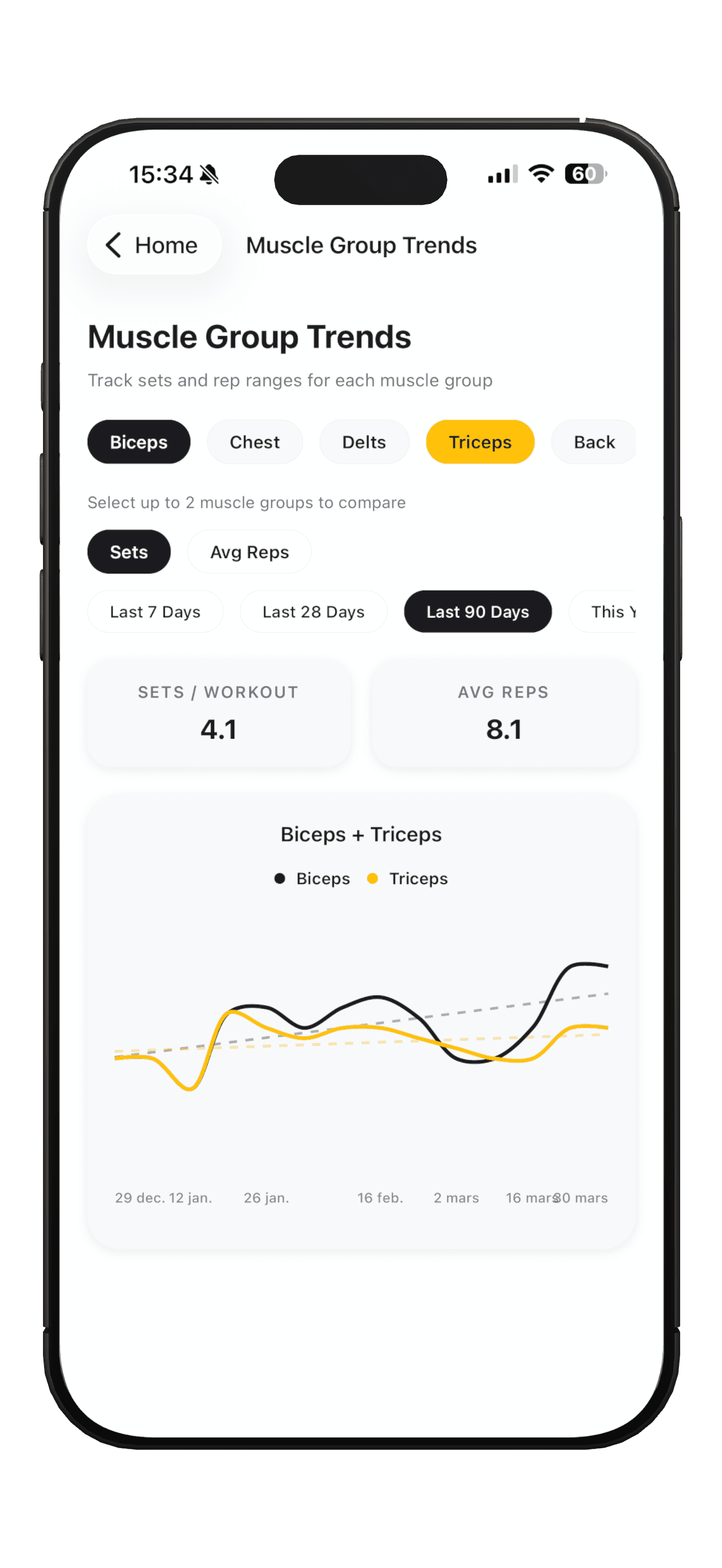
Momentum tracking ties it all together. Instead of wondering whether you've been progressing over the last few weeks, you can see it. Momentum shows you the trend across sessions, so you know whether your program is producing adaptation or whether it's time to change something. It turns progressive overload from a concept you hope applies to you into something you can actually see on screen.
It also removes the blank-page problem. Proven programs with built-in progression mean you're not staring at an empty workout wondering what to do. You bring the effort, GainsLog handles the structure and tells you whether that effort is paying off.
Because the best training advice in the world means nothing if you can't see whether it's working.